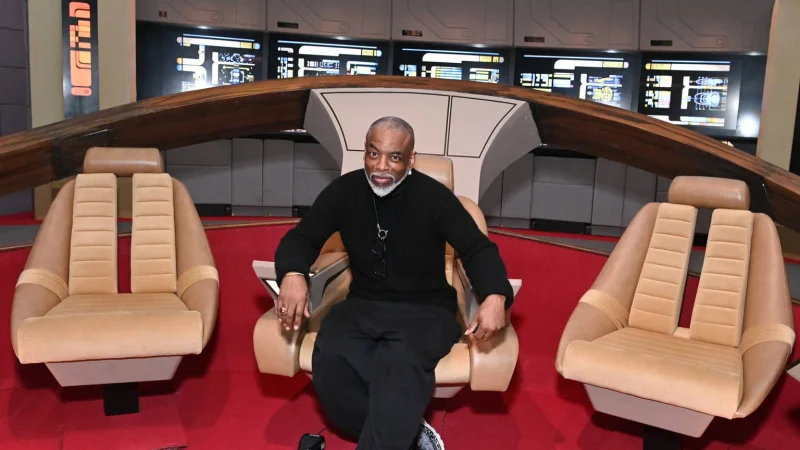
LeVar Burton is turning to his past this fall with a memoir that puts his estranged father at the center of the story. Take My Word for It is set for publication by Random House on Nov. 10, and it reaches back to a childhood in Sacramento shaped by absence, a mother who kept the family moving forward, and a career that made him one of the most recognizable figures in television.
Burton’s name still carries the weight of Reading Rainbow, Roots and Star Trek: The Next Generation, but the new book is built around the family story behind those credits. He told AARP that after his parents split when he was 11, he had no contact with his father for years and did not reconnect until Roots had already made him famous a decade later. That long break is part of what gives the memoir its pull now: readers know Burton as a literacy advocate and a beloved screen presence, but the book asks what came before that public life.
He wrote the memoir with Tracey Michae'l Lewis-Giggetts, and early praise has already framed it as something more intimate than a standard celebrity recollection. Burton said the book traces his upbringing in the 1960s and the influence of his mother, a high school English teacher who was the first person in her family to graduate from college. He writes, “I am who I am because of my mother. Full stop,” a line that places her at the center of the story even as his father remains the emotional fault line running through it.

The book also connects the personal to the professional in a way Burton has been building for decades. He said dropping out of college to play Kunta Kinte in the 1977 miniseries Roots changed how he understood his identity, and that his 23 years on Reading Rainbow gave him the credibility to become a leading voice for literacy. In his telling, the arc runs from enslavement to space flight, from Kunta Kinte in Roots to Geordi La Forge, and from a childhood defined by distance to a public life defined by access and education.
Yet the most revealing part of the memoir may be the one Burton leaves unresolved. He said his father passed recently and called their relationship pretty complex, but also said, “I felt complete.” That is not the language of tidy closure. It suggests a man who has already done the work of making peace, even if the reasons for the estrangement are still partly offstage. Take My Word for It arrives with that uncertainty intact, and that may be why it feels less like a victory lap than a final accounting.
On Nov. 10, readers will get Burton’s version of the life behind the roles, including the silence that shaped it.