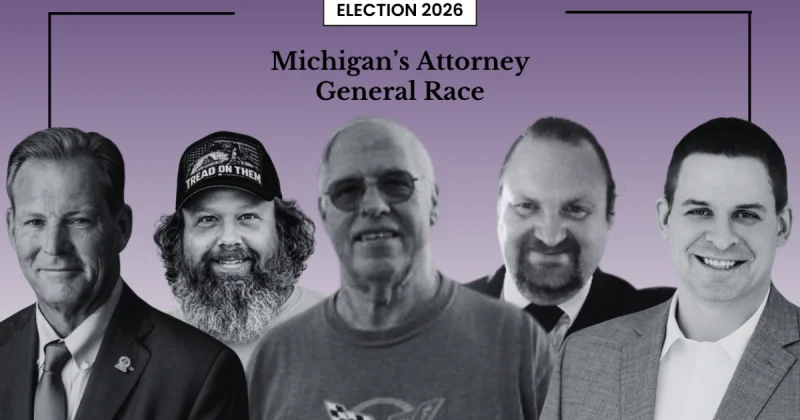
Michigan’s race for attorney general is no longer about the office in the abstract. With Current Attorney General Dana Nessel term limited, the candidates now have to say what they would actually do with the state’s top law enforcement job, and Michigan Public asked them to spell it out before Nov. 3.
That matters because the job is bigger than courtroom appearances. The next attorney general will decide when to sue the federal government, when to challenge utility rate increases, when to issue legal opinions on legislation and when to prosecute offenses large and small. Those powers reach into state politics, state spending and the daily fights that shape whether laws get enforced or blocked.
The interviews also exposed a sharp divide over who is even fit to hold the title. Only three of the candidates are lawyers recognized by the state bar, even though state law does not explicitly say the attorney general must be a bar member. The law does require anyone who calls themselves an attorney or lawyer to be a bar member, and Aman McLeod, a University of Detroit Mercy Law professor, pointed to a 1937 Michigan Supreme Court ruling that said the rule implicitly applies to anyone holding the title of attorney general.

That question is not theoretical. Earlier this year, when the Republican-led state House unilaterally canceled hundreds of millions of dollars in state spending, Nessel responded with an opinion saying the cuts were unconstitutional. The House GOP sued, and the dispute eventually ended in a settlement. A bill later surfaced to limit the attorney general’s power to issue opinions, and it passed the House but then sat for months in the Democrat-led state Senate.
Some candidates said that kind of authority is exactly why the job should be open to people with different backgrounds. Jason Dye, the Libertarian Party candidate, argued that a bar membership requirement violates the U.S. Constitution. He said he would get rid of the bar association, and he said his work running the We The People News website showed he could manage a team of attorneys. Dye also said he is 1000% against data centers and Flock license plate cameras, and suggested forming a militia in response to data center development.
Jeff Polonowski, the Green Party candidate, made the most direct case that he could handle the office without being a lawyer. He said he would not need to be an attorney because he would mainly be managing the state’s lawyers. Polonowski is a chemist and Otsego Township planning commissioner, and he said he has been involved in some zoning lawsuits. Still, he acknowledged the gap in his résumé, saying explaining how that background prepared him to manage a team of attorneys would be “a hard one to explain.”
The next attorney general will also inherit Nessel’s habit of pushing the office into the state’s biggest fights. She frequently files testimony against utility rate increases before the Michigan Public Service Commission, and most recently argued that the commission unlawfully approved special contracts for the Oracle and OpenAI data center in Saline Township. That is the reality voters will be choosing on Nov. 3: not just a name, but a legal posture for four years of fights over money, power and the limits of state authority.