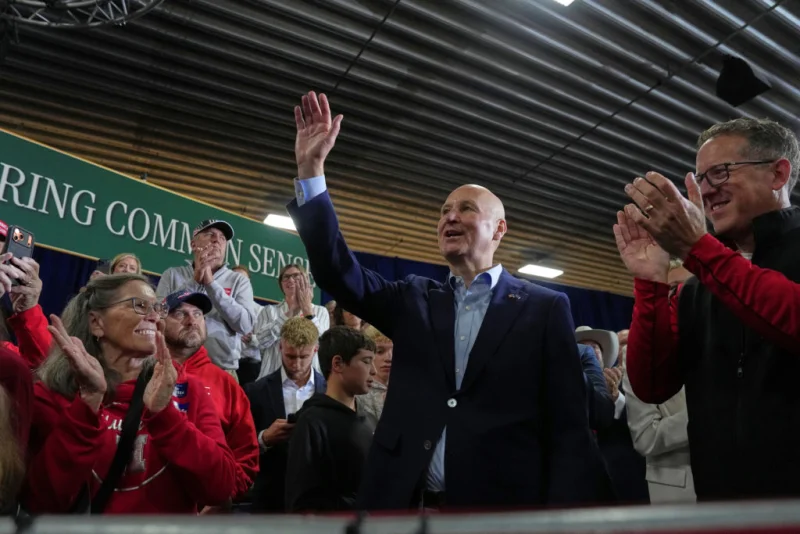
Pete Ricketts is running against Dan Osborn in Nebraska’s U.S. Senate race, and the contest has quickly become one of the clearest tests of whether Republicans can keep their edge in the state. Ricketts is the Republican incumbent. Osborn is an Independent who says he will not caucus with Democrats or Republicans.
That stance has helped define why Osborn remains a serious candidate. It is also why his campaign is being watched so closely: he has taken money from Democratic donors even as he argues he would not line up with either party in Washington. In a race where party control matters, that contradiction is impossible to ignore.
Osborn is not a new face to Nebraska voters. He spent nearly two decades at Kellogg's, worked as a mechanic at the plant in Omaha in 2021, and led a 77-day strike before he was fired. He then ran for U.S. Senate against Deb Fischer in 2024 and lost by 7 percentage points, a margin that made him one of the strongest nonpartisan challengers in the state in recent memory.

Ricketts brings a much different record. He was appointed to the Senate in 2023 to fill Ben Sasse’s term, then won the same seat in a special election the next year by more than 25 percentage points. Donald Trump carried Nebraska by 20 percentage points, which is part of why Republicans have treated the state as safely red for years. Osborn’s near-miss last year is the reason that confidence is now under pressure.
The money gap is real, but it is not decisive. As of mid-October, Ricketts had raised $14.5 million and Osborn $11 million, and millions more in outside spending have poured into the race. That broader flood of money has only sharpened the stakes, because Nebraska Republicans are already facing unexpected resistance in other contests this cycle.
The strain is not limited to the Senate race. Democrats are also targeting Nebraska’s 2nd Congressional District again, where Denise Powell is running against Brinker Harding, an Omaha City Councilor, for the seat being left by retiring Republican Don Bacon. The district includes Omaha and is sometimes called the blue dot, and in June the Democratic Congressional Campaign Committee added Powell to its Red to Blue program. Bacon has criticized the Trump administration over Ukraine and tariffs, another sign that even familiar Republican terrain is less settled than it used to be.
Nebraska has not backed a Democratic presidential candidate since 1964, and that history still weighs heavily on every statewide race. But this Senate contest is no longer just about the state’s long Republican habit. It is about whether Osborn can turn his 2024 close call into a breakthrough, or whether Ricketts can convert the state’s partisan lean into another win that steadies Republicans in Washington.