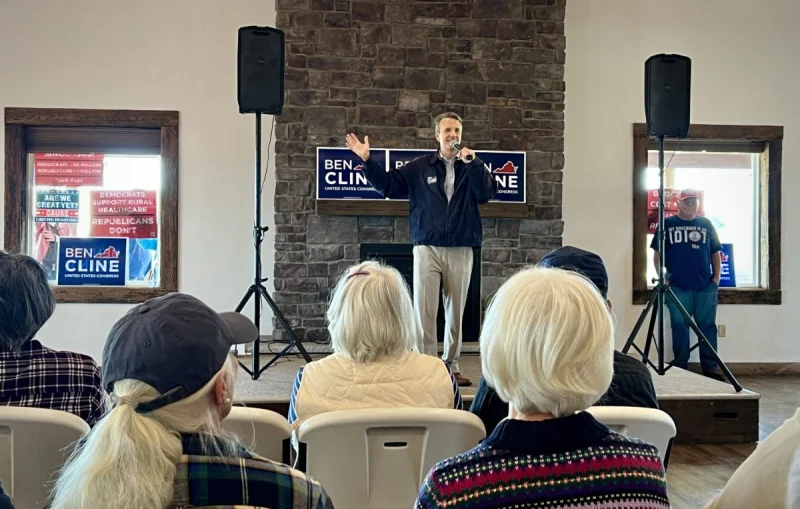
Ben Cline used a Winchester rally on Tuesday morning to turn Virginia Democrats’ redistricting fight into a campaign attack, telling supporters they wanted to split his district five different ways. He said they were trying to carve it up, send it into so many Fairfax-faced seats and silence voters in the valley.
The rally landed a few weeks before the midterm elections, when Cline is trying to defend a district that has been reliably Republican for decades. The 6th Congressional District, which runs from the Shenandoah Valley to the Roanoke Valley, has gone to Republicans by comfortable double-digit margins in every election with a challenger on the ballot since 1992, and Cline won reelection in 2024 by 28.3 percentage points. Even so, the race is drawing attention now because the campaign is no longer just about party lines; it is also about whether Democrats can make any headway in a district that has usually been out of reach.

That is why the fundraising numbers matter. As of October 14, Beth Macy had outraised Cline, taking in $2.9 million from more than 4,513 individual contributions, compared with his $1.9 million from more than 1,225 individual contributions. Her campaign also pulled in $712,989 in small-dollar contributions, far more than his $81,034, and the Federal Elections Commission counts small-dollar gifts as under $200. In a district where the Cook Political Report calls the race solidly Republican and Sabato’s Crystal Ball says it is safe Republican, that gap gives Democrats a foothold even if the map itself never changes.
The scene outside the venue underscored the clash. Supporters of Macy were turned away and pressed signs against the windows, including one that read, “Groceries cost more? Thank a Republican,” while law enforcement later escorted protesters away after the blinds were lowered. Cline, speaking to the crowd inside, urged people to “wave to the Democrats outside” and asked whether they were going to let anyone silence their voice. The rally was the first of three he planned that day, a sign that he is treating both the redistricting fight and the money race as part of the same message: the district may be safe on paper, but it is not being taken for granted.
That is the unresolved point for Cline and for Virginia Democrats as the campaign moves on. The redistricting effort remains part of the backdrop, not a finished map, and the question now is whether the political pressure he described can be turned into votes strong enough to preserve the district’s long Republican streak.