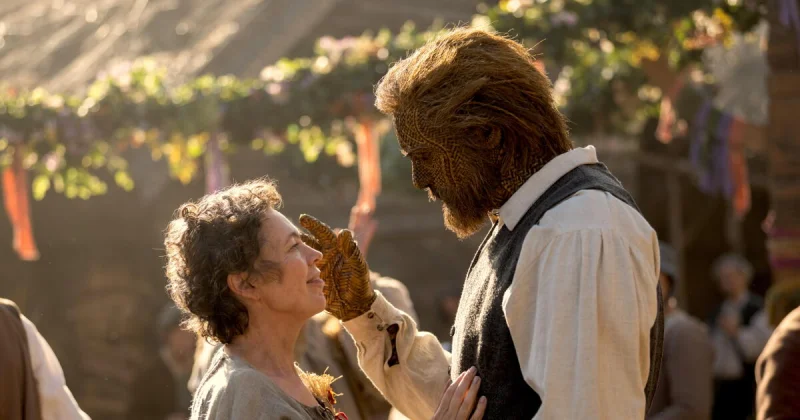
The Los Angeles Times has reviewed Wicker, a film that turns Alexander Skarsgård into a man molded out of twigs and asks viewers to treat that as a romantic lead. In a story built around a lonely fisherwoman and the basket-weaver who makes him, the result is part fairy tale, part dirty joke and part love story.
That odd setup is why Wicker is getting attention now. It is adapted from The Wicker Husband, Ursula Wills-Jones’ 10-page short story, and the film keeps the premise intact enough to make the casting feel like the joke and the point at once. Peter Dinklage plays the unnamed basket-weaver who braids the husband for Olivia Colman’s lonely virgin fisherwoman, and the review treats Colman’s performance as the anchor that makes the fantasy land.
The film’s appeal, at least for the first stretch, comes from how far it commits to the bit. The review calls it mischievous and crowd-pleasing, with several sweet beats of romance, and says the opening stretch delivers Reason No. 1 to watch: the sight of Skarsgård formed from twigs, down to the face, arms, pecs and abs. It also leans into the absurd social details around that world, where weddings include brides wearing a heavy matrimonial collar and grooms strapping carrots to their crotches and wagging them at goats.

Colman’s character is not the only one framed as a social outsider. Elizabeth Debicki appears as a queen bee snob who is the doctor’s daughter, another sign that the film wants to use its strange body-comedy as a way to needle village status games. Sofi Marshall handled the editing and Lol Crawley the camerawork, giving the project the polished look of a mainstream release even when the material veers into the ridiculous.
The sharpest thing the review says is also the one that keeps the film from sounding fully satisfying: viewers may wish for more time with Skarsgård and Colman together. The setup promises a full romantic pairing, but the movie is described as offering only about 15 worthwhile minutes of the kooky smut before pulling back. That leaves Wicker as a film with a strong idea and a strong mood, but one that seems to know exactly how much of its own strange charm it is willing to spend.
It is also framed as a twist on a familiar monster story, except here the monster is wanted, not feared. The review’s comparison is simple enough to land: it is Frankenstein if the crowd wanted to be with the monster. That is the movie’s real gamble, and it is why the unanswered question matters less than the one the film already answers: whether a twig-made husband can carry a whole fantasy on his own. For a while, the answer appears to be yes.