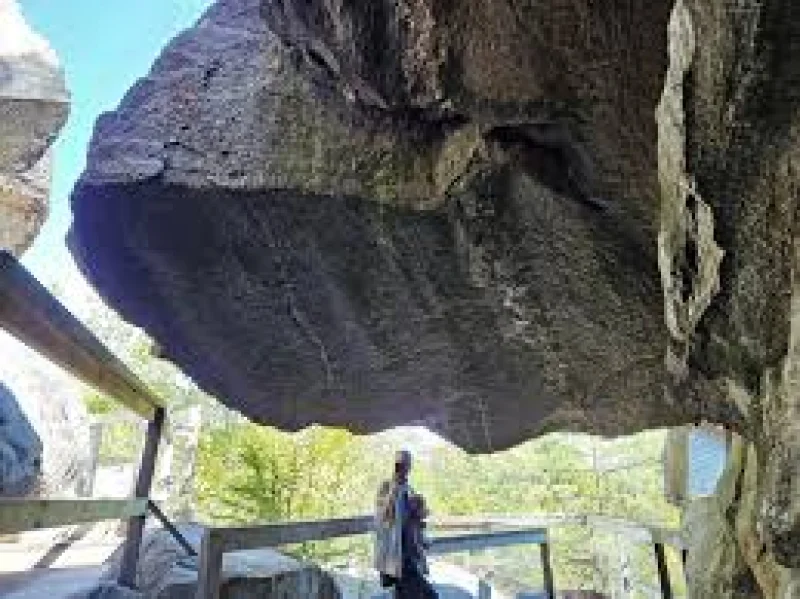
An 80-ton boulder that had stood at Polar Caves Park in New Hampshire for the entire 104-year life of the park fell on Sunday, knocking out part of a trail at the tourist site. Park management said nobody was hurt when the rock came down and that no one was in its path.
The collapse put new attention on the Mysterious Hanging Boulder, a landmark that had long hovered just above hikers' heads as they moved along the trail. The park announced the news on Monday and said the fall came after decades of the rock holding its place over the walkway.
The size of the rock made the damage hard to miss. Video from the scene showed a railing for the trail's wooden walkway smashed to pieces, and access to the rest of the trail was cut off by the fallen boulder. A trail sign in the video said the rock overhang was cracked all the way through, rested on 3 contact points in the back and had 75 percent of its weight hanging over hikers' heads.

Joe Licciardi said the granite boulder was deposited in that hanging position by a glacier thousands of years ago. He said the caves at Polar Caves are named for the spaces between enormous granite boulders left by glaciers, and Jan Earle said the rock was balanced, with some of its weight resting on its base and some hanging over the trail. Earle said gravity and erosion of the base had been working on it for years, and Licciardi said freezing and thawing water can expand by roughly 9 percent, enough to make a rock further fracture and crumble.
That is what makes the fall harder to dismiss as a one-off. The boulder had survived for generations, yet the park said it came down when nobody was beneath it, turning a long-known feature into a safety problem in a single afternoon.
A safety assessment will be conducted during the park's offseason, and that will determine how much of the damaged area can be restored before visitors return. For now, the question is not why the boulder mattered; it is what the park can safely reopen after a rock that had lasted 104 years finally gave way.