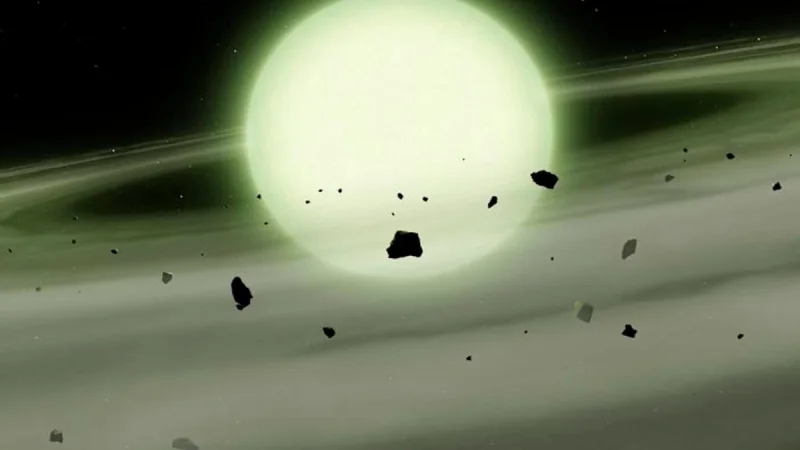
Astronomers have identified WD J1330+6435 as the first white dwarf to appear green to the human eye after it swallowed rocky material from its planetary system. The finding gives a rare color to a dead stellar core and ties that color to debris that once belonged to planets, asteroids or comets.
That is why the Green Star is drawing attention now. The work, published in RAS Technique and Instruments, comes from a study that examined white dwarf spectra and then ran them through a human color-vision model. In that framework, WD J1330+6435 stands out at about 7,232 degrees Fahrenheit, or 4,000 degrees Celsius, and roughly 284 light-years from Earth.
Mark Hollands said the result caught him off guard. “Most stars, including most white dwarfs, behave like ‘perfect radiators,’ so their color is set almost entirely by temperature. But nobody had really looked into what else might be possible for white dwarfs,” he said. He added that these dense stars can produce colors nobody expected, and that some of them genuinely surprised him.

The reason is that white dwarfs are not simple glowing embers. When a star like the Sun burns through its nuclear fuel, it sheds its outer layers and leaves behind a dense, dead core. That core can be extremely hot, and white dwarfs have long been known to look white or pale blue. But the coolest ones can develop atmospheres with densities comparable to water, and in some cases those atmospheres are millions of times more dense than the Sun's photosphere. In that environment, trace elements such as carbon, calcium and sodium interact with dense helium plasma and absorb light across a much wider range of colors than they would lower down in density.
That is what makes the new result unusual. Carbon-rich white dwarfs are typically pink or purple. Others that have fed on debris from shattered asteroids and comets, or the remains of old planetary systems, lean more toward yellow. Cooler white dwarfs with mixed hydrogen and helium atmospheres often take on a cyan or pale blue tinge. Green had not been part of the usual lineup. The study says planetary debris can widen the color range still further, but it does not show that green is a common outcome. It also does not identify any earlier white dwarf that had been observed looking green before this one.
So WD J1330+6435 matters because it pushes the color of a white dwarf beyond the familiar blue-white palette without changing the basic physics of what a white dwarf is. The star is 284 light-years away, but the bigger distance may be conceptual: astronomers now have a case showing that composition and density can shift a white dwarf's visible color in ways that temperature alone does not predict. What remains unclear is how much rocky material it swallowed, and exactly how that debris and atmosphere combined to produce the green seen by the human eye.