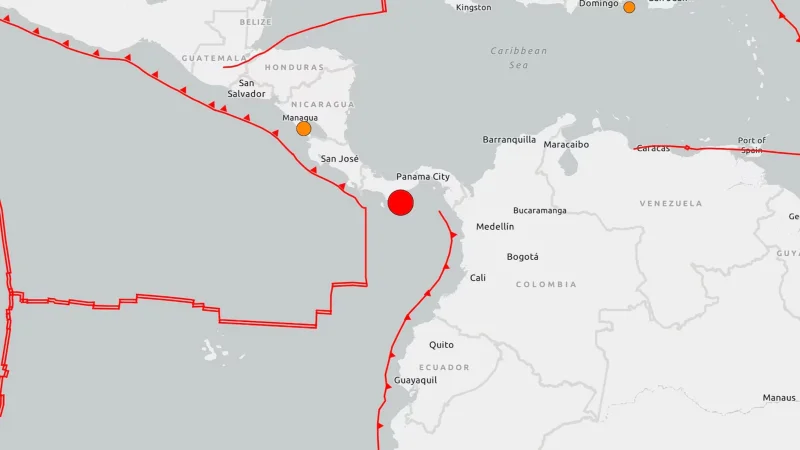
Two powerful earthquakes struck Panama on Friday afternoon, shaking central provinces, triggering evacuations and sending people outside as aftershocks kept coming. The first quake measured 7.7 magnitude after the U.S. Geological Survey revised its initial reading from 8 to 7.6 and then 7.7, while a second 6.6 magnitude quake followed later.
Rosendo Domínguez felt the shaking at home and watched it turn ordinary kitchen items into flying hazards. “We felt it very strongly. It knocked things over in the kitchen, but we’re okay, though we’re very scared,” he said. “Everyone is outside, scared.”
The first quake was centered about 10 kilometers southwest of Pitaloza Arriba in Herrera province, at a depth of 10 kilometers, and the shaking was strong enough to be felt as far away as neighboring Colombia. Seismologists at the University of Panama recorded more than 45 aftershocks, including some that reached magnitude 5.8, 5.5 and 5.2. By Friday, the pattern was clear: this was not a single jolt, but a sequence of tremors that kept the ground moving long after the first rupture.

Damage was concentrated in Veraguas, Herrera and Los Santos, with no damage reported in Panama City. Several injuries were reported, including one person struck by debris from a partially collapsed structure in Penonomé. The cathedral in Penonomé’s main square had a partial collapse and cracks, the governor’s office building and the Dos Continentes hotel were damaged, and the Church of San Atanasio in Los Santos province reportedly collapsed. Large fissures also ran along roadways in Veraguas.
That contrast between the capital and the central provinces mattered because the disruption spread unevenly. Omar Smith said the damage was concentrated in the central provinces and that there were no reports of damage in Panama City, even as the earthquakes led to airport evacuations and visible destruction elsewhere. Tocumen International Airport temporarily suspended operations and activated evacuation plans before saying flights would resume once security conditions had been checked.
The Panama Canal Authority said operations continued normally along the Panama Canal, with specialized technical teams inspecting facilities for possible damage. José Raúl Mulino urged the public not to turn the quakes into alarm or disorder. The broader answer on Friday was plain enough: the country took a real seismic hit, the capital was spared the worst of it, and the next reckoning will come from inspections that determine how much damage the aftershocks and the main shocks actually left behind.