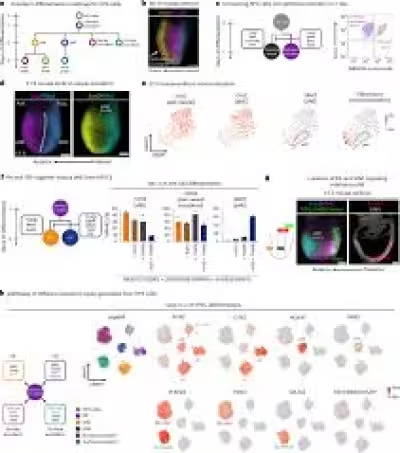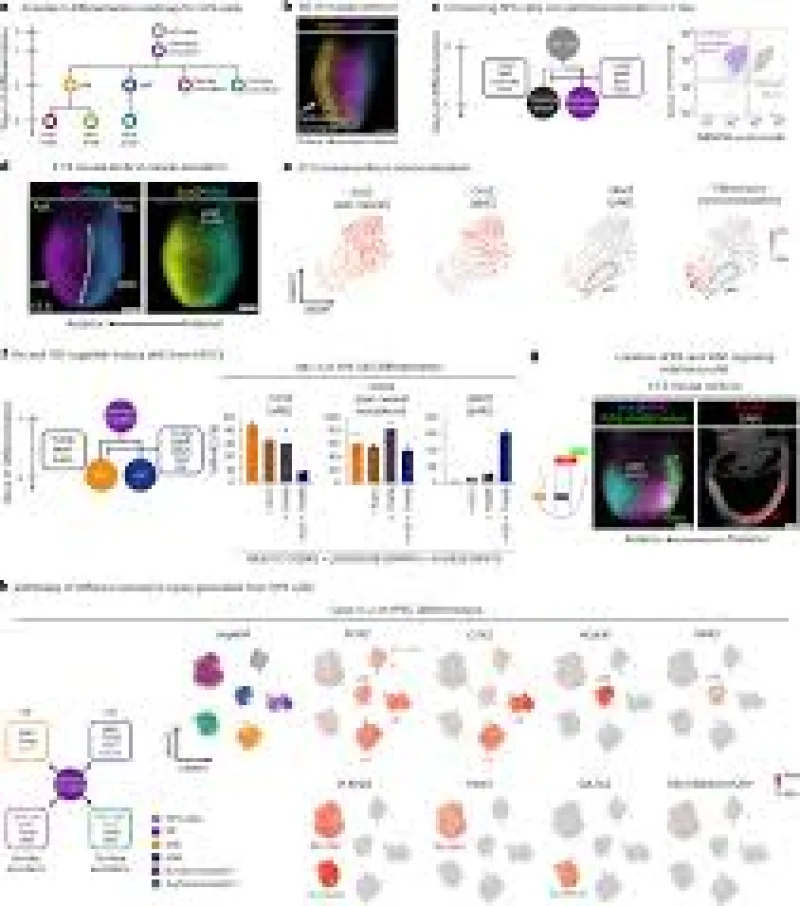
Stanford Medicine researchers have found that the human brain is not built as one seamless unit but as two separate organs adjacent to one another, each with its own developmental origin. The discovery, published on Sept. 18 in Nature Neuroscience, upends a long-held view of how the brain is put together and helps explain why scientists have struggled for decades to grow some brain cells in the laboratory.
The finding is drawing attention now because it directly answers a question that has shaped brain research for generations: what did Stanford researchers discover about the human brain being two separate organs? Their answer is that the front of the brain and the back of the brain do not come from the same starting point. The front arises from a totally different progenitor cell than the back, meaning the hindbrain follows its own path during gastrulation while the pathway that creates the forebrain and midbrain unfolds in parallel.
Kyle Loh, the senior author, said that the team had shown for the first time that the front of the brain arises from a totally different progenitor cell than the back. He said the work now makes it possible to grow neurons from the back of the brain, the hindbrain, in a petri dish and study what they do. Carolyn Dundes and Rayyan Jokhai, the study’s co-first authors, made that result possible by tracing how the two regions develop from the start.

That distinction matters because the adult brain has three main regions, and the hindbrain does jobs that keep the body alive from one moment to the next. The forebrain handles language, consciousness and abstract reasoning. The hindbrain controls breathing, sleeping, heartbeat and hunger urges, and its neurons also control muscles of the face, tongue and throat. For researchers trying to model those cells, the hurdle has been stubborn: for decades, they have struggled to generate human hindbrain neurons in the lab.
The new work suggests the obstacle was not just technical. It was developmental. If the hindbrain and forebrain begin from different progenitor cells, then a one-pathway model cannot fully explain how the brain forms. That helps reconcile a contradiction at the center of the field, where scientists long treated the brain as a single, unified organ even as their lab methods repeatedly failed to recreate its back-end cells with consistency.
The practical payoff could come in diseases that strike the brain stem, including SMA and ALS. SMA is a leading genetic cause of death in children under 1 year of age, while ALS is often diagnosed between the ages of 40 and 70 and affects both the forebrain and the hindbrain. By showing that hindbrain neurons can now be grown in a petri dish, the study gives researchers a cleaner way to examine how those cells function and why they fail.
What remains unresolved is how broadly this two-organs model will reshape the field. The study gives a new developmental map, but the next step is whether other labs can use it to build the same hindbrain cell types and whether that approach reveals something the old model missed. For now, the larger message is plain: the brain’s front and back do not just do different jobs. They begin life differently, too.