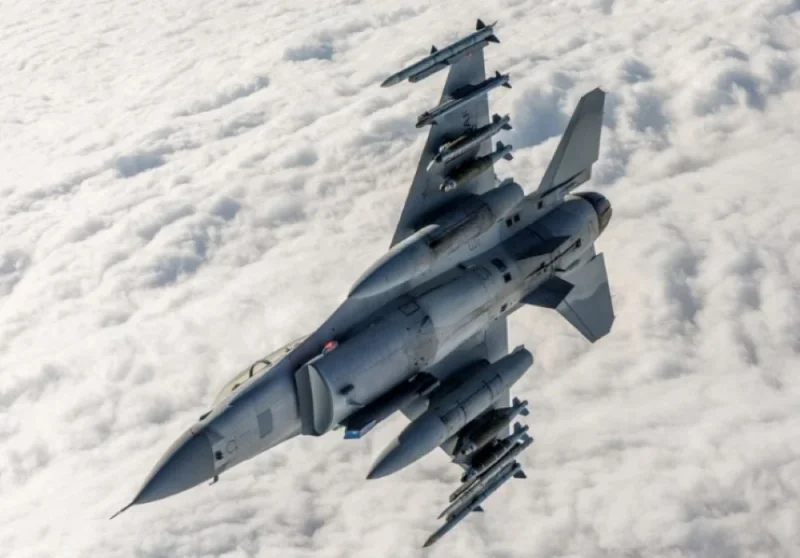
Lockheed Martin and the U.S. Air Force are once again talking about new-build F-16s, reviving a fighter option the service has not committed to buy but has not ruled out either. The renewed discussion centers on a proposed F-16G, an enhanced derivative of the F-16 Block 70, as the Air Force searches for ways to ease pressure on a fleet that is aging, shrinking and becoming more expensive to keep in the air.
The timing matters because the service is still deciding how to cover more missions with fewer aircraft. It is investing heavily in the F-15EX, but it is also looking for a lower-cost non-stealth fighter that could help replace aging units without forcing every gap to be filled by an F-35. That search is what puts the F-16 back into view now, not as a relic, but as a possible stopgap that could stretch capacity while the Air Force sorts out its longer-term force mix.
Lockheed Martin’s pitch for the F-16G is built around added capability rather than a clean-sheet redesign. The proposed jet reportedly would include conformal fuel tanks, 600-gallon wing tanks, an infrared search-and-track system, a Sniper targeting pod and a drag chute. In practical terms, that would make it a more capable version of the Block 70, aimed at USAF F-16 units whose current aircraft are nearing the end of their useful lives. It would also let the Air Force keep much of the training, maintenance and infrastructure already tied to the aircraft family.

That is also why the idea is being discussed at all. A new Viper variant based on the Block 70 would be cheaper than replacing an aging F-16 with an F-35, and far less disruptive to operate over its service life. But the Air Force has still not settled on the requirements or even the range of options it wants to pursue, and that leaves the proposal in an awkward place: attractive on paper, unresolved in practice.
The friction point is industrial as much as it is strategic. The existing Block 70/72 line is already heavily occupied by foreign military sales, which means any U.S.-configured variant would have to find room in a production system that is already busy. That issue surfaced in May 2025, when Sen. Tom Cotton asked then-Air Force Chief of Staff Gen. David Allvin about buying a U.S.-configured Block 80 F-16 if Congress added money. Allvin did not endorse the idea, but he did not dismiss it either. He said he needed to examine how long it would take to adapt the Block 70 design, where a U.S. aircraft could fit into Lockheed Martin’s production line and what the industrial base could support.
Allvin also made clear why the service is even looking at this class of aircraft. He said the Air Force needed the high-end capability required for an Indo-Pacific fight and other fighters that may not need to be as so. That is the core of the debate now: whether the Air Force will define a real requirement for a cheaper, non-stealth fighter and fund it, or leave the F-16G as another option that was discussed but never ordered.