George W. Bush said in Dallas on Sept. 9 that the Sept. 11 attacks were not a law-enforcement event. They were a war, he said, putting fresh words to the way the attacks redirected his presidency and the country.
The timing matters because the remarks came at an event tied to the 25th anniversary of the attacks. Bush was in office for only eight months when Andy Card leaned in to whisper, while a child was reading in a Florida classroom, that America was under attack.
The memory is still sharp because the scene was so ordinary and the news so catastrophic. Bush had been sitting in front of second graders when Card delivered the warning. The attacks on the World Trade Center, the Pentagon and a hijacked plane crash in Pennsylvania killed nearly 3,000 people and shattered Americans’ sense of safety.
Bush said he did not have much time to process what was happening, but he quickly understood what the moment demanded. “There was no doubt in my mind that this was not a law-enforcement event. This was a war,” he said. He also recalled that if the country was under attack, his job was to defend the child reading to him, her family and her country.

That line captures the turn his presidency took after Sept. 11. Before the attacks, Bush was focused mostly on domestic concerns such as education reform. Afterward, he shifted toward national security and antiterrorism policy, a change that would define the rest of his time in the White House.
The break with his original plans is part of why the episode still resonates. Dan Caine said Bush did not sign up to become a wartime president, but he became one. Bush’s approval rating jumped to 90% in a Gallup poll one week after the attacks, a measure of how quickly the country rallied around him even as the crisis deepened.
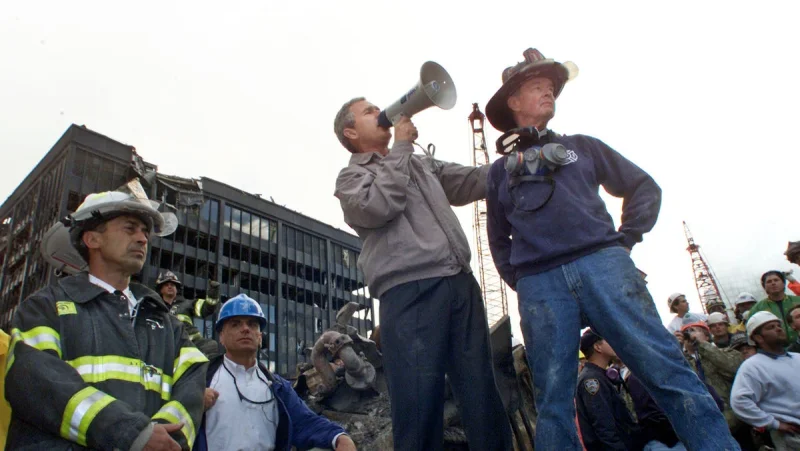
He also moved into the public eye in a way that became inseparable from 9/11 itself. Three days after the attacks, Bush stood atop a crumpled firetruck in New York and told first responders, “I can hear you,” using a bullhorn to answer the fear and anger of the moment.
Barbara Perry said people described the period after the attacks as feeling like every day was 9/12, which helps explain why the anniversary still lands with such force. Bush entered the White House after a 36-day recount in Florida that ended with a divided Supreme Court, but 9/11 overrode the political fight that had brought him there and remade the presidency around war, security and the long afterlife of the attacks.
What Bush made clear in Dallas is that he sees the meaning of 9/11 in plain terms: it was the day the presidency changed, and the question it raised was never whether he would be tested again, but how fully the country understood the war that began that morning.