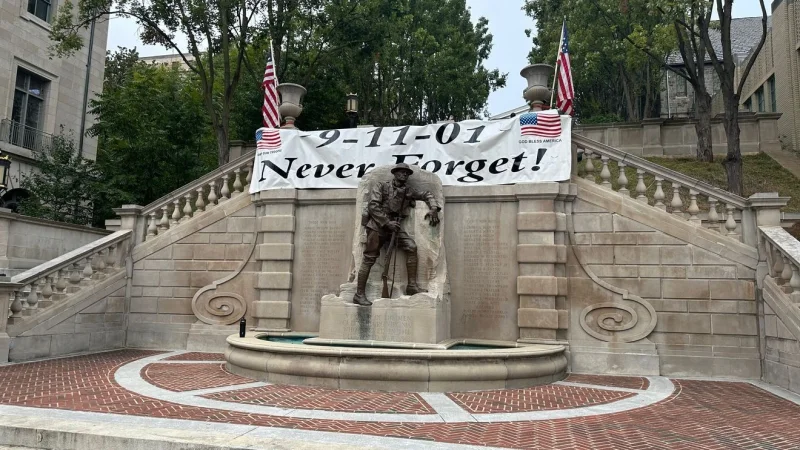
Twenty-five years after Sept. 11, 2001, Penn officials say the attacks permanently changed how the University prepares for emergencies and secures campus life. What had been a crisis plan in progress became a fuller Emergency Preparedness Plan in the summer of 2001, with tailored preparations for each school and center and a system for sharing those plans with fire and police so they could quickly get access to the information they need about that building in case of an emergency.
That shift matters now because Penn is revisiting the changes on the anniversary of the attacks, when the campus is being measured not just by what it lost, but by how it adapted. The University says large events now involve more extensive coordination, including work with the Philadelphia Police Department’s Ordnance Disposal Unit and bomb unit, plus sweeps with the City of Philadelphia, Amtrak, and SEPTA police.
Frank Plantan said the attacks changed the way the campus accepted security tools that had faced strong resistance before. He said there had been massive resistance from students and faculty to closed-circuit TV cameras, and that Penn Security had been trying to put them on campus for years before 9/11. After the attacks, he said, that resistance broke down.

Kathleen Shields Anderson offered a different frame. She said she understood why people saw a correlation between the attacks and Penn’s CCTV expansion, but said the rollout began well before Sept. 11, 2001. That distinction matters because it suggests 9/11 did not create Penn’s security overhaul from nothing so much as accelerate a change already underway, turning a debate about convenience and privacy into one about risk.
The broader national climate also helps explain why the University moved so far and so fast. Michael Horowitz said that after 9/11, the risk was thought to be high enough that people were willing to experience lots of disruptions to decrease the potential risk of another attack. He said police departments across the country had SWAT teams and armored vehicles within a few years, that federal funding for local response did not exist before 9/11, and that the attacks shattered the post-Cold War illusion that American power would insulate the United States from consequential attacks.
Penn’s own response reached beyond cameras and barricades. The University did not maintain an active K-9 unit before the attacks, but by 2025 the Penn Vet Working Dog Center had graduated nearly 200 detection dogs. The result is a campus that still reflects the logic of 2001: more planning, more coordination and less patience for the idea that a large, open university can be protected with a light touch. The question now is not whether 9/11 changed Penn. It is how much of the current system was built in response to that day, and how much had already started before it.