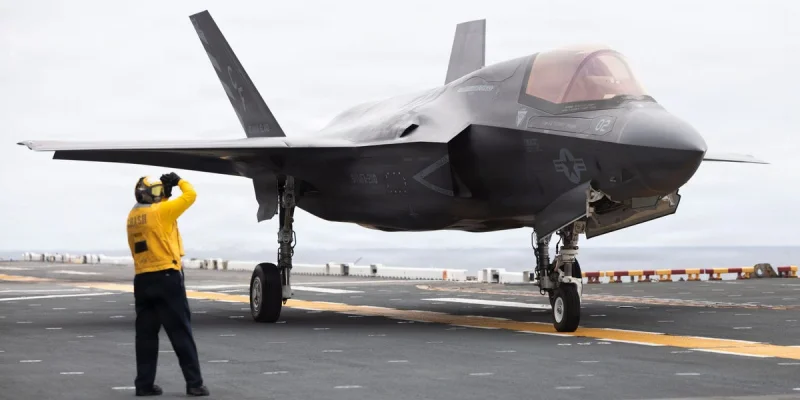
Former Marine Harrier pilots are having to unlearn the instincts that helped them survive deck landings as they move into the F-35B. The difference is not subtle. A technique that worked in the Harrier can make the newer jet pick up speed and climb when the pilot tries to settle it onto an amphibious warship.
The shift matters now because the Marine Corps retired its final operational Harrier squadron this year, and many of the pilots who flew that aircraft are being sent to the F-35. Last month, pilots aboard the USS Makin Island described what that means in practice during deployment training for the 13th Marine Expeditionary Unit. For readers searching the F-35B, the question is not whether the aircraft can land vertically — it can — but how long it takes pilots who spent years in the Harrier to stop flying it like one.
Travis Theimer is one of them. He logged nearly 700 hours in the Harrier before transitioning to the F-35, and his experience captures the adjustment underway across the Marine Corps. The AV-8B Harrier forced pilots to manage three different controls to hover: direction, engine throttle and a nozzle lever. To land on a ship, they practiced a box pattern around the landing pad, moving left, backward, right and forward while hovering and watching the aircraft settle.

That old muscle memory does not disappear just because the cockpit changes. Former Harrier pilots may instinctively pull back and add power on F-35 approaches, a reflex that can make the aircraft accelerate and climb instead of slowing into the deck. The F-35B is designed to reduce that burden, with onboard computers handling most of the vertical landing work and flight-control software able to maintain a hover and match the speed of the warship below. But the transition still asks pilots to let the machine do more of the job than they are used to doing themselves.
Michael Jones said the move is like going from a unicycle to a bike. That comparison fits the bigger shift. The Harrier was primarily an air-to-ground attack aircraft during the post-9/11 wars in Iraq and Afghanistan, while the F-35 can fight in the air, strike enemy air defenses and share information with nearby aircraft and troops on the ground. The old jet demanded constant hands-on management. The new one is built to help.
The unanswered piece is how long that relearning takes. The Marine Corps has already made the decision to move on from the Harrier, so the remaining work is not about whether former Harrier pilots will adapt to the F-35B. It is about how quickly they can stop relying on habits that once kept them safe and start trusting a jet that is doing more of the landing for them.