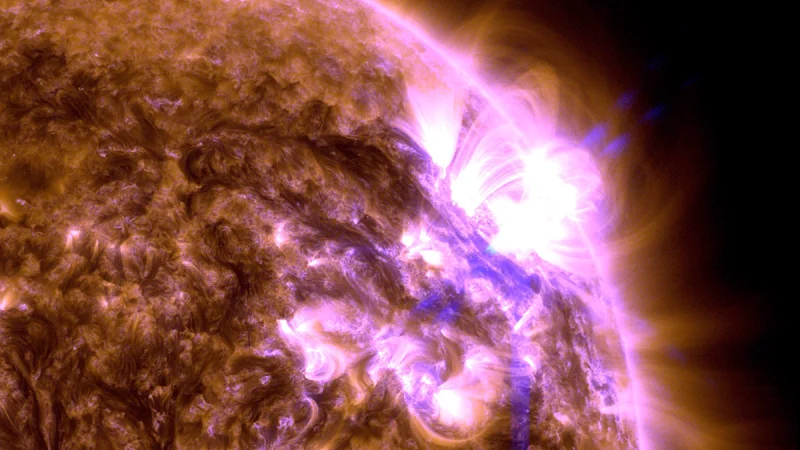
A November 2025 solar storm did more than light up Earth’s skies. Scientists led by Endawoke Yizengaw of The Aerospace Corporation found that it also drove coast-to-coast disturbances across the continental US and pushed GPS errors beyond 10 meters in some places, a level of interference that can matter far beyond the skywatching spectacle.
That matters now because the disruption was not a small, local wobble. The researchers said the GPS error could have reached 33 feet, enough to disrupt precision agriculture and autonomous vehicles, and their findings were published in Geophysical Research Letters.
The storm came after Earth was buffeted by several massive eruptions of solar material that slammed into the magnetosphere, and as the storm intensified the auroral oval expanded toward the equator. The same event produced dazzling auroras to rare low latitudes, but the atmospheric response was more complicated than the light show suggested. Using aurora cameras and a network of ground-based Global Navigation Satellite System receivers across North America, the team saw a huge band of enhanced electron density stretching eastward through the atmosphere.

That detail helps explain the scale of the disruption. During a geomagnetic storm, energetic particles can rain down into the ionosphere, where GPS signals travel and where density fluctuations can distort and diffract radio waves. Mid-latitudes are usually treated as relatively calm and safe for ionospheric scintillation, which is why the coast-to-coast reach of this storm stood out so sharply to the researchers.
The work also underscores a broader problem for technology that depends on clean signals. Solar flares can temporarily disrupt high-frequency radio communications, and solar storms can disturb power grids as well as the shape of the atmosphere. In this case, the concern was not only a dramatic aurora display but a GPS system thrown off enough to affect precision applications that depend on reliable positioning.
Yizengaw said the results underscore the importance of accurate understanding of space weather phenomena to improve predictive capabilities through coordinated observations and physics-based modeling and to reduce disruptions to RF applications during space weather events. The unanswered question is not whether the storm mattered. It did. What remains for operators is how long the coast-to-coast disturbance and the GPS error lasted while the November 2025 storm was at its peak.