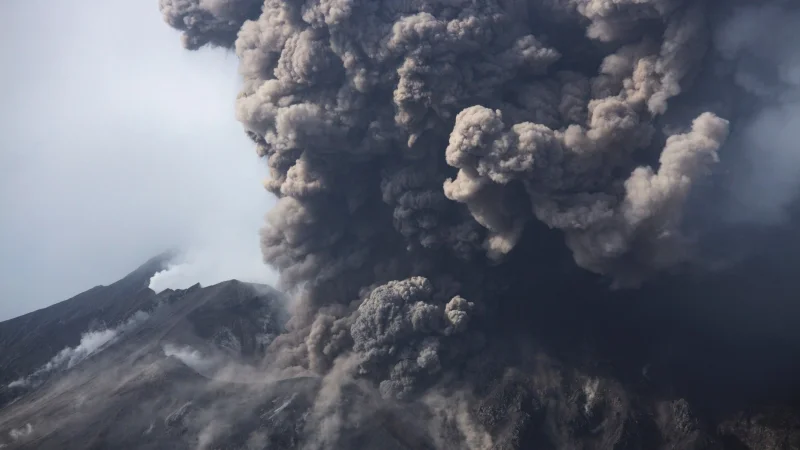
Scientists have identified the remains of a vast supervolcano deep beneath England's east coast, one that erupted about 454 million years ago and was centred under The Wash before stretching into Norfolk and Lincolnshire. The buried volcano, measured at least 65km across, had enough force to hurl hundreds of cubic km of rock and ash into the sky.
The finding matters now because it came from a fresh look at old material. During the Covid lockdown, researchers reexamined archived borehole samples kept by the British Geological Survey in Keyworth, Nottinghamshire, and found tiny zircon crystals that dated the Norfolk and Lincolnshire rocks to about 454.4 million years ago. That work linked the two sets of samples to the same volcano and gave scientists a new map of a landscape that has sat unseen for millions of years.
Dr Tim Pharaoh called the discovery a “fantastic result” that is changing “our understanding of England's deep geological past”. He said the volcano erupted with the force of several thousand hydrogen bombs, long before dinosaurs walked the planet, and that the eruption likely explains a thick layer of volcanic ash found across Norway, Sweden, the Baltic region, Belarus and Poland. The age matched material analysed by the University of Oslo, strengthening the case that ash from eastern England was carried far across what is now northern Europe and settled on the sea floor.
The find also complicates the simple picture that often comes with the word supervolcano. A supervolcano is defined by eruptions of more than 1,000 cubic km of material, and while that threshold puts today’s giants such as Yellowstone and Lake Tabo in Indonesia in a very different league, Pharaoh said this ancient system is extinct and cannot come back to life. “Unlike faults, which can be seismically reactivated, a volcano can't,” he said. “Once it's gone extinct, that's it. Nobody needs to worry about the supervolcano erupting again.”
There is still one striking reason the discovery took so long to surface in the first place: there is no trace of it above ground. The volcano is buried beneath one of England's flattest landscapes, hidden under The Wash and the surrounding counties rather than standing as a cone or ridge, and Pharaoh said he had spent much of his 40-year career at BGS thinking about earlier work by University of East Anglia scientists. What changed was not the land itself, but the tools used to read what was already in the archive.
For now, the picture is clear enough to settle one question and leave another behind. Scientists have a dated eruption, a buried source and a wide ash trail across Europe. What remains less obvious is how much more of England’s deep geology is still sitting in old samples, waiting for a second look.