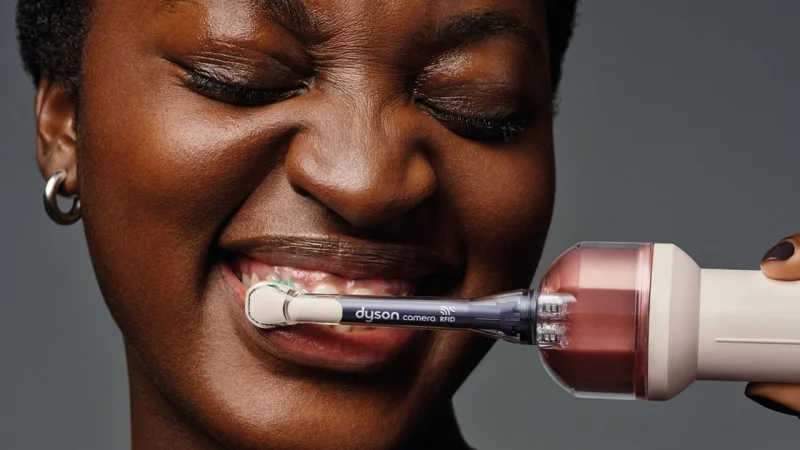
Dyson has put a camera inside a toothbrush. The new CameraJet went on sale today for $499, making it the company’s first electric toothbrush with a camera built into the brush head and a spray system that aims mouthwash between teeth.
That matters because the device is not just trying to brush better; it is trying to show users what they are missing. The CameraJet can livestream video over Wi-Fi to a phone, while its AI system, which Dyson calls Gap Optical Targeting, analyzes 28 live images every second and fires a cone-shaped burst of mouthwash within 100 milliseconds of spotting a gap between teeth. For people who do not floss as often as they should, that puts the pitch in plain terms: see the gap, hit the gap, move on.
Dyson says the blast is wider than what water flossers typically use, with the idea that a broader spray can remove plaque with less pressure. The brush head itself still works like an electric toothbrush, oscillating nearly 1,000 times each second, so the CameraJet is not replacing brushing. It is adding a second layer aimed at the spaces that brushing usually misses.
The price is where the new product gets complicated. At $499, the CameraJet lands in the same neighborhood as other premium smart toothbrushes, but it is still a sharp ask for a tool that is being sold on the promise of making an everyday routine more exact. Dyson is also building in a three-month replacement reminder through RFID-tagged brush heads, which means the owner is not just buying a device but signing up for a steady stream of consumables. The company has not said what those replacement heads will cost, and it has not set pricing for the non-foaming toothpaste and low-foaming mouthwash it plans to sell alongside them.
There is also a practical question hidden inside the gadgetry. The CameraJet does not store the images it sees on the device or send them to the cloud, which keeps the focus on live guidance rather than recordkeeping. The built-in mouthwash reservoir holds 12.5ml, and the docking station can refill it in three seconds, suggesting a product designed for speed as much as precision. But the real test is simpler: whether a camera, a sensor and a fast spray can make a premium toothbrush feel like more than a premium gimmick.
For Dyson, the CameraJet extends a personal-care business that has largely been built around hair-focused devices into a new corner of the bathroom. For buyers, it is a polished answer to a very old problem: the spaces between teeth are still hard to clean, and now one company is betting that a camera and AI can make the job feel less like a chore and more like a system.