SpaceX is building a dedicated blade factory to make turbine blades and vanes in-house, a move aimed at fixing a problem that has slowed Raptor engine production for years. Elon Musk said this week that the company spent so many years on the turbine blade cracking problem.
The reason it matters is simple: the blades inside Raptor's turbopumps are among the most punishing parts of the engine, and SpaceX needs Raptor engines in the hundreds to fully outfit Starship. A crack that starts in a turbine blade can race through the part and trigger catastrophic engine failure in milliseconds, which is why a single component can become a production bottleneck for an entire launch system.

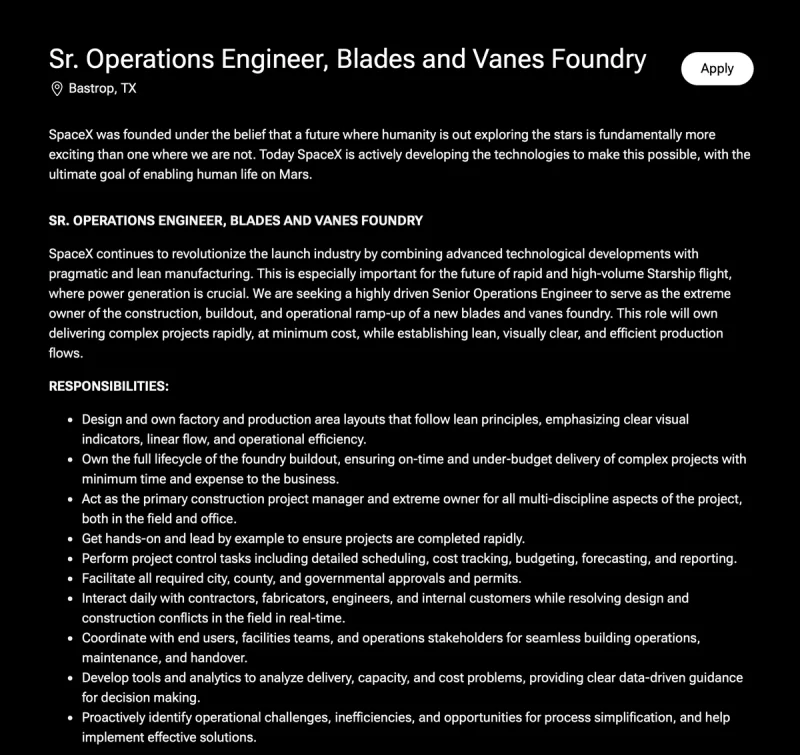
The Information reported this week that SpaceX is building a dedicated turbine-blade factory, and the company's own hiring points in the same direction. Several months before that report, SpaceX posted a job listing for a Senior Operations Engineer to lead a blades and vanes foundry and handle the construction, buildout and operational ramp-up of the facility. That is not the language of a lab project. It is the language of industrial scale.
The foundry would give SpaceX direct control over material composition, casting geometry, heat treatment and quality inspection, which matters when a design must survive extreme thermal and mechanical stress. The bigger prize is speed. SpaceX wants to iterate quickly when new cracking modes show up, and making blades in-house is the only way to do that without waiting on suppliers that may not move fast enough for a program pushing toward Mars, point-to-point Earth transport and Starlink satellite deployment.
That is also the hard part. Solving blade cracking in a lab and producing hundreds of blades a month are different jobs entirely. One is a technical breakthrough; the other is a manufacturing system with tight process control, repeatable output and no tolerance for drift. SpaceX has historically been reluctant to outsource critical propulsion parts because supply-chain dependence is treated as an existential risk, and the new foundry fits that logic. The unanswered question is not whether SpaceX wants control. It is how quickly the company can turn the foundry from a buildout into steady production.