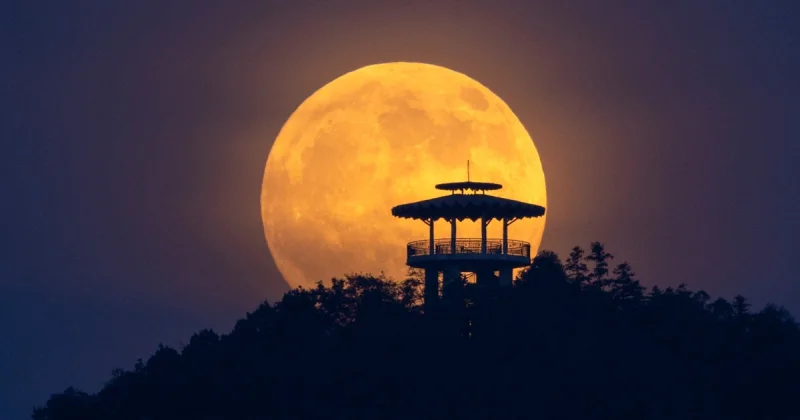
A near-total lunar eclipse will turn the moon reddish orange Thursday night as nearly the entire lunar surface slips into Earth’s shadow. The event begins at 9:23 p.m. ET and reaches its deepest point at 12:12 a.m. ET, when 96.2% of the moon will be covered.
That is why people are searching why is the moon red tonight. During the eclipse, Earth sits between the sun and the moon, and its shadow colors the moon in a muted red-orange rather than leaving it black. The reason is Earth’s atmosphere, which scatters sunlight before some of it bends into the shadow and reaches the lunar surface.
Denise Chow’s timing makes the viewing window plain enough to plan around: the eclipse will end at 3:01 a.m. ET, and most viewers in North and South America except those in Alaska and the northernmost reaches of Canada will be able to follow every stage. Observers across North and South America, along with parts of Europe and Africa, can see at least part of the event, and lunar eclipses can be watched safely with the naked eye.
The part that catches the eye is also the part that keeps the science honest. This is being called near-total, but it will not cover the whole moon; at peak, 96.2% of the lunar surface will be in Earth’s shadow, leaving only a sliver outside it. Binoculars and telescopes can make the view more dramatic, but they are not required.
The timing also fits a familiar celestial pattern. Lunar eclipses happen when Earth slips between the sun and the moon during the full moon phase, while solar eclipses happen during the new moon phase. A total lunar eclipse is also known as a blood moon, and solar and lunar eclipses often come in pairs because of the way the moon, Earth and sun interact.
This eclipse follows a total solar eclipse that darkened skies in Spain, a small part of Portugal, Greenland, Iceland and northern Russia. The next solar eclipse will be visible on Feb. 6 in parts of South America and Africa, and the next lunar eclipse will come overnight from Feb. 20 to 21. For skywatchers, Thursday night is the one that answers the question in real time: the moon looks red because Earth’s air bends and scatters sunlight into the shadow before it reaches the lunar surface.