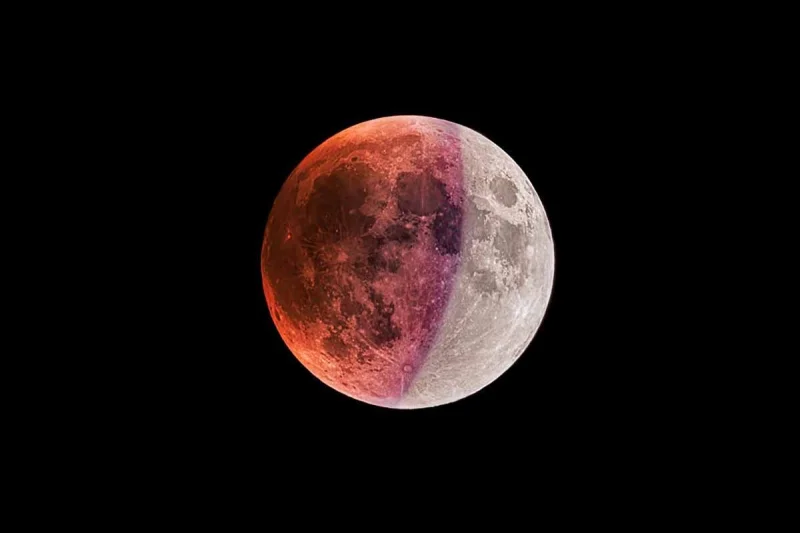
A deep partial lunar eclipse will sweep across North America on the evening of August 27/28, 2026, turning nearly the whole Moon a copper red or deep orange shade. About 96% of the full Moon’s surface will move into Earth’s shadow, close enough to look like a Blood Moon without becoming one.
That is why people in the USA and Canada are searching now for August 2026 Lunar Eclipse Viewing: this is one of the most striking nighttime sky events on the calendar, and it lands on the full Moon. August’s full Moon is known as the Sturgeon Moon, and for this one, Earth will pass directly between the Moon and the Sun, cutting off the ordinary white glare that usually dominates a full Moon.
The scale matters. Lunar eclipses do not happen every full Moon because the Moon usually slips above or below Earth’s shadow. When the alignment is right, the difference between a total and partial eclipse is simple: a total eclipse covers the Moon completely, while a partial eclipse leaves part of it uncovered. In this case, the uncovered portion will be small. Most of the Earth-facing side of the Moon will still be darkened and tinted by the eclipse, which is why it will look so close to a true Blood Moon.

The color comes from the way light bends through Earth’s atmosphere. Some sunlight is filtered through the air before reaching the Moon, and Earth’s thick atmosphere scatters blue wavelengths more strongly. What gets through is the redder light, which is why the Moon can take on that dramatic copper or orange look instead of disappearing altogether.
That is also the catch for anyone expecting a clean total eclipse: this one stops just short of totality. The distinction is small on paper and obvious in practice. A total lunar eclipse would swallow the Moon completely into Earth’s shadow. This one leaves a sliver of the full Moon outside the shadow, but not enough to change the impression for most observers. It should still be one of the most photogenic lunar events of 2026.
What the public still does not have, at least from the available details, is the exact local timing across North America. The event is fixed for August 27/28, 2026, but the best moment to watch will depend on where people are looking from within the USA and Canada. For now, the answer for viewers is straightforward: mark the full Moon, expect a near-Blood Moon, and watch for the part of the night when the eclipse reaches its deepest red-orange phase.