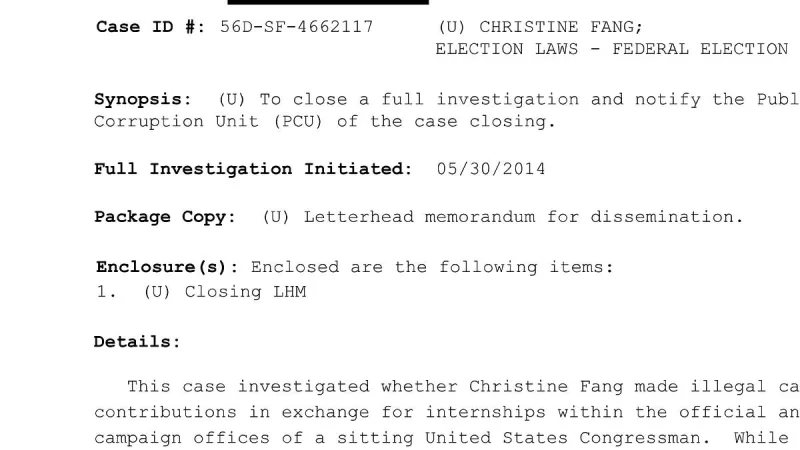
Declassified FBI records show the bureau opened a full public-corruption investigation into Eric Swalwell over allegations tied to Christine Fang, a probe that reached the point of possible bribery and foreign-contribution violations. The files say investigators looked at whether campaign money and access were being traded through intermediaries, and whether interns were being steered into his congressional office in exchange for political help.
The reason Fang Fang is being searched now is simple: the records are newly disclosed, and they lay out the breadth of the case in a way that had not been public before. The investigation was codenamed Freshman Fifteen, and a June 2014 FBI memorandum listed possible violations including bribery of public officials, conspiracy, excessive campaign contributions, prohibited foreign-national contributions and contributions through conduits.
Those records also show how seriously the bureau treated the matter. The U.S. Attorney’s Office for the Northern District of California was notified before the case was opened, and an Assistant U.S. Attorney agreed to prosecute if agents developed enough evidence. By March 2015, agents wrote that several donations had been routed through intermediaries and that, in at least two cases, Fang used conduits to conceal herself as the prohibited foreign-national source of the money.
That mattered because Swalwell’s campaign had already received $1,145,688 in individual contributions between January 2013 and December 2014, giving investigators a large stream of donations to examine. The files also describe a Chinese national volunteering in the campaign, a wealthy winery owner told agents Fang said to “just bring his checkbook” because she would reimburse his donation, and a fast-food franchise magnate who said Fang wanted his contribution credited to her. Investigators were not looking at a single suspicious check. They were trying to map a network.
The case also carried a complication that made it unusual even by Washington standards. The records describe a documented sexual relationship between Fang and Swalwell while the FBI was treating the matter as a Sensitive Investigative Matter because one of its subjects was a sitting member of Congress. That combination gives the probe a sharper edge: it was not just about influence, but about whether personal access, political money and foreign ties were being braided together in the same relationship.
The bureau did not rely on paper alone. On June 16, 2014, two FBI agents spent more than three hours on surveillance at a California shopping center, and at 8:42 p.m. they watched an Asian woman in red shoes descend an escalator and cross the parking lot while appearing to interact with a cellphone. The files show the investigation used physical surveillance, confidential sources, search warrants and an undercover operation, which is why the declassified material reads less like a political dustup than a fully developed federal case.
What the records do not show is just as important. They do not confirm whether the attempted prosecution ever moved forward, whether charges were filed or whether the case was closed. For now, the newly opened record establishes the scale of the FBI’s interest and leaves the final outcome unresolved.