


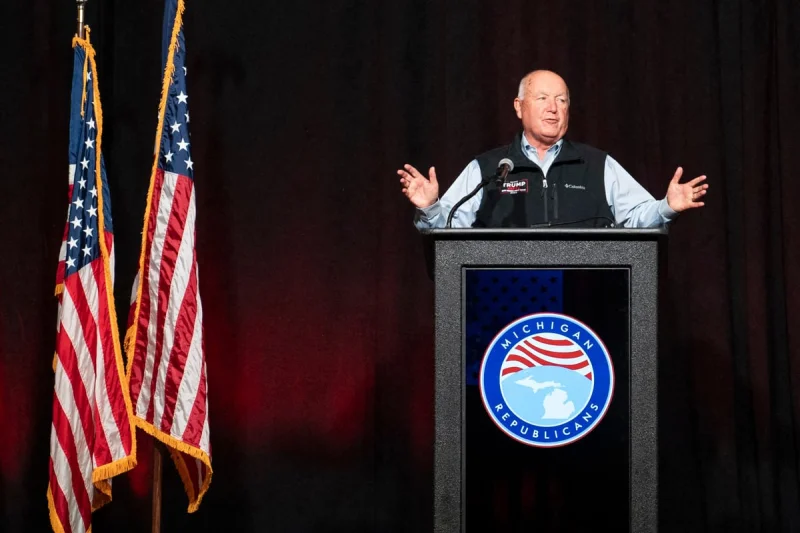
More than 29,000 Canadians have signed a petition seeking to have Pete Hoekstra expelled from Canada and removed as the US Ambassador to Canada, putting the diplomat at the center of a rare public challenge that will be carried to Canada's House of Commons this fall.
The timing matters because the petition is already large enough to force the issue into Parliament, and because it targets a sitting ambassador over what supporters call repeated interventions in Canadian political discourse. Hoekstra is accused of making statements that undermine Canada-US diplomatic relations, including calling the 2025 Canadian federal election anti-American and describing threats to annex Canada as the 51st state as a term of endearment.

That is the core of the pete hoekstra petition now circulating in Canada: it does not just object to his tone, but asks Ottawa to declare him persona non grata and raise his conduct with the US as inconsistent with the Vienna Convention on Diplomatic Relations. The petition also seeks a parliamentary committee review of Washington's diplomatic interference in Canada, turning a partisan-sounding dispute into a formal test of how much public criticism an ambassador can bring into the relationship.
The clash is sharpened by Hoekstra's own complaints. He has accused Canada of interfering in US domestic politics, while the petition says he crossed the line by speaking repeatedly and directly about Canadian politics. In January, he said, “We do not need Canada.” In July, he claimed President Donald Trump's tariff attacks had actually helped Canada and falsely suggested Ottawa had not really paid for the Gordie Howe International Bridge. He also said, “You do not come into America and start running political ads, government-funded political ads… and expect that there will be no consequences,” a remark that further fed the criticism.
The Vienna Convention on Diplomatic Relations, established in 1961, is the framework that governs how diplomats are supposed to behave and what rights and responsibilities come with the job. That is why the petition's language matters: it is not only asking for political disapproval, but for a judgment that Hoekstra's public comments have gone beyond the bounds of ordinary diplomatic friction. What happens next is straightforward and consequential. The petition will be presented to Canada's House of Commons this fall, and once it is, lawmakers will have to decide whether to let the complaint stand as a symbolic protest or push it into a broader review.
