


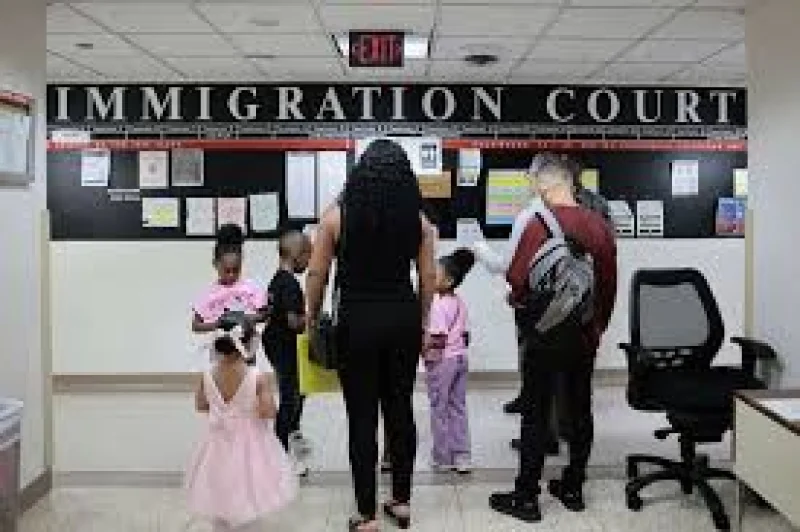
A California federal judge ordered the Trump administration on Thursday to pay $65 million to nonprofit legal service providers that represent unaccompanied migrant children, a ruling that could refill depleted reserves for groups still waiting on overdue money. The order gives the U.S. Department of Health and Human Services until Friday afternoon to move the funds.
For Michael Lukens, the ruling lands at a moment when the bills have stacked up and the work has not stopped. The Amica Center for Immigrant Rights, which handles hundreds of cases for children in Maryland, Washington, D.C., and Virginia, said it was owed more than $2.5 million for work already done, much of it for children in Maryland. Lukens said the organization was finally able to replenish money it had been pulling from reserves after waiting on those payments.
The Amica Center is one of nearly 100 nonprofits covered by the court order, which addresses more than $65 million in unpaid fees tied to deportation cases for unaccompanied migrant children. The organizations are part of a network under the Acacia Center for Justice, which had spent years under contract with HHS to provide legal services for these children. That contract was not renewed last year and expired on July 31, leaving the payment fight to unfold just as some children went to court this week without lawyers.

The gap between the court order and the contract problem is what gives the ruling its force and its limits. Court records showed payments were already being processed by 4 p.m. local time and were expected to reach organizations on Monday, but that does not fix the bigger question of how the legal work continues if the contract remains expired. Lukens said the Amica Center did not tell child clients they might lose their attorney because of a contract issue, adding that the group’s mandate was to help the children and that it did so every day this week.
There is also a separate path for the children’s legal defense that has not been explained in full. The Trump administration awarded a $150 million contract to the Burke Law Group to provide legal services to these children, according to an report, but how that arrangement will be carried out for children already moving through deportation cases is still unclear. The result is a system in which one set of providers is being ordered paid for past work while the broader structure that supports those cases remains unsettled.
Lukens said the administration is trying to deport as many children as possible, and that the number of local cases has started to fall, though not by much. For now, the judge’s order means cash should start moving, but the unresolved contract issue means the next round of legal help still depends on a decision that has not been made.
