


Spain’s claim over Melilla and Ceuta is back under scrutiny after renewed pressure at the border fence in Ceuta, and the argument being made is blunt: Morocco has never exercised sovereignty over either enclave. The case rests on a chain of control that, its defenders say, began centuries before the modern Moroccan state existed.
That is why Melilla keeps coming up now. Readers searching the name are running into a sovereignty dispute tied not only to history, but to the live frontier between Spain and Morocco and to the way the European Union’s external border is drawn. The question is no longer just who held what in the past. It is how that past is being used to defend the present.
The chronology starts early. In the third century, Diocleciano created the Diócesis Hispaniae, and Abyla and Rusadir were administered from Emerita Augusta. In the early eighth century, Don Julián was governor of Ceuta, and Wamba was described as the conqueror of Septem. By the tenth century, the Califato de Córdoba included Ceuta and Melilla among its defensive outposts in North Africa. The line the article draws is clear: these were not lands of a Moroccan state, but territories absorbed into changing imperial and peninsular systems long before the current sovereignty map took shape.
For Melilla, the key date is 1497, when Spanish presence consolidated after a conquest described as without violence. Ceuta followed its own path. It was definitively incorporated into the Monarquía Hispánica in 1580, and that incorporation was ratified in the Tratado de Lisboa in 1668. By the mid-20th century, the two cities had more than four centuries of uninterrupted integration in the Spanish legal, territorial, and political order. The modern Reino de Marruecos, by contrast, did not exist as a state until independence from France in 1956.

That is the legal hinge of the argument. If a state did not yet exist, the claim goes, it could not have possessed sovereignty over territory already integrated into another order for centuries. The article uses that timeline to push back against Moroccan claims and to frame Ceuta and Melilla as Spanish sovereign territories whose status was not created in the postcolonial era but inherited from a much older chain of rule.
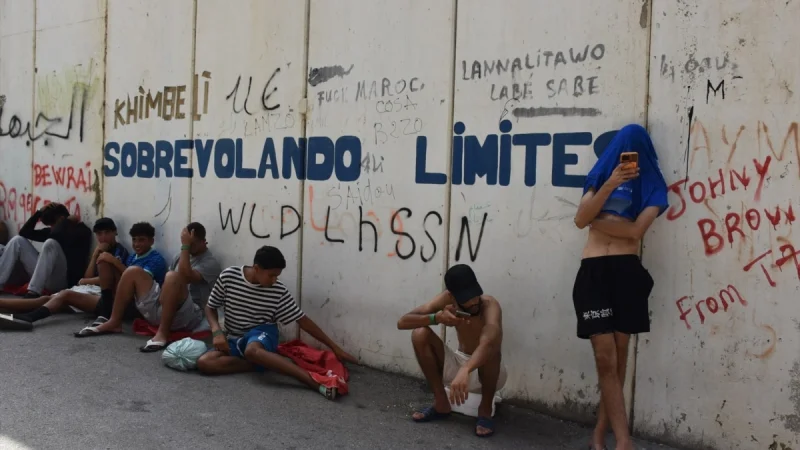
Yet the border does not move according to legal memory alone. The pressure at the fence in Ceuta is linked to socioeconomic deterioration in the Sahel and northern Morocco, along with organized people-smuggling mafias. That friction matters because it keeps the dispute alive in practical terms, even as the sovereignty claim is presented as settled in law. The same frontier that is described as fixed on paper is still exposed to movement, coercion, and political sensitivity.
The European dimension also tightens the stakes. Spain entered the Comunidades Europeas in 1986, and the Statutes of Autonomy of Ceuta and Melilla were ratified in 1995. From that point on, the article’s sources describe the two cities as full external borders of the European Union. In other words, the border is not only Spanish. It is built into the EU frontier system itself.
That leaves the argument with a hard edge and an unfinished end. The historical record cited here is deployed to support Spanish sovereignty, but the border crisis at Ceuta shows that legal certainty has not dissolved political pressure. The next issue is not whether the past exists. It is whether that past can continue to hold the line against the realities pressing on it now.
Ruben Amon presents in Melilla ‘Morante, punto y aparte’ on May 23.
