


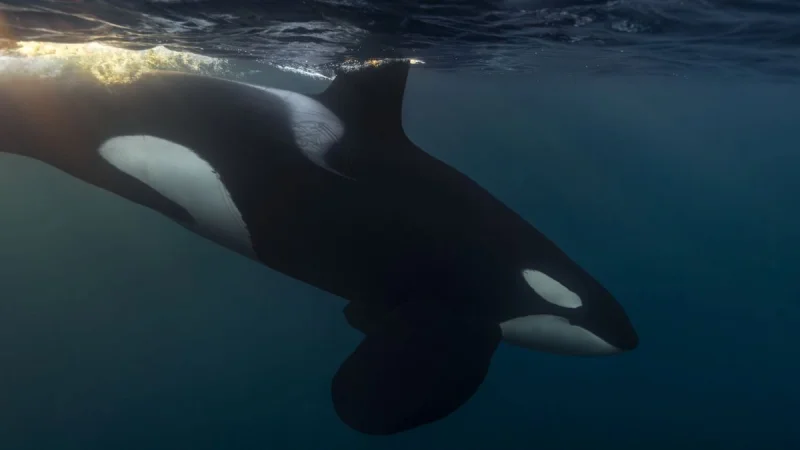
A small change in sound can change who stays and who goes. Scientists reported in January 2026 that when long-finned pilot whales are nearby, orcas may pack up and leave after reacting to the pilot whales’ vocal signals.
That finding is getting attention now because it turns a familiar ocean hierarchy on its head. Orcas are the oceans’ apex predators, yet Anna Selbmann and colleagues wrote in Scientific Reports that killer whales respond to the acoustic signals of pilot whales and likely read their presence as a threat. Selbmann said the puzzle is not just that orcas react, but that they appear to avoid a smaller animal that seems, on paper, easier to ignore.
The paper builds on a pattern scientists have been tracking for years. In 2012, Charlotte Curé reported that playing orca vocalizations to long-finned pilot whales in the wild acted like a siren call they could not resist, and the whales moved toward the sound when it was within hearing range. That earlier observation helped frame the newer question from the other side of the encounter: if pilot whales are drawn toward orca sounds, why do orcas appear to pull back when pilot whales are present?

Evidence from the field makes the reaction harder to dismiss as a fluke. Renaud de Stephanis and colleagues noted in a 2014 paper that in every documented wild encounter between pilot whales and orcas from 2004, the orcas left. A field investigation in the Strait of Gibraltar also found that the two cetacean species do not compete for the same food and do not prey upon each other, which strips away the simplest explanations for the retreat.
That is where the friction sits. Orcas are larger, are described as apex predators, and are built for dominance in the water. Long-finned pilot whales are significantly smaller. Yet the available observations point to a repeated imbalance in behavior, not size. Something in the pilot whales’ acoustic signals appears to matter enough to make orcas treat the encounter as risky, even though scientists still cannot say what that signal means or why it carries that weight.
Selbmann and her colleagues said they wanted to study more interactions between the two species, and that is likely where the answer will have to come from. For now, the strongest conclusion is also the strangest one: in these encounters, the smaller whale appears to set the terms. What remains unresolved is not whether orcas react, but what exactly they think they are hearing.
