


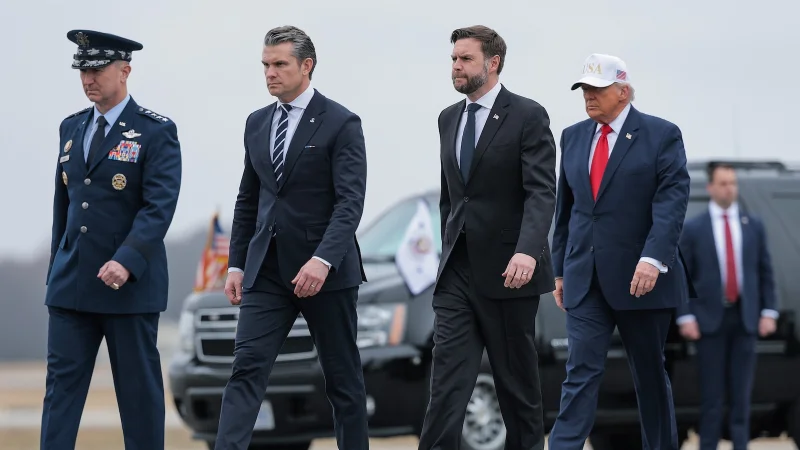
President Donald Trump held off on a threatened military escalation against Iran after advisers at the White House on Friday warned about what could follow. The pause came after senior officials and advisers laid out options, implications and concerns, and it left diplomacy alive even as the confrontation stayed volatile.
Trump said on Monday that “All of the people that deal with Iran asked me: 'Don't fire,'” a line that captures how quickly the debate turned from force to restraint. The search for a ceasefire matters now because the decision was not made in a vacuum; it came at a moment when the White House was still weighing how far to push Iran and whether another round of strikes would produce leverage or a wider fight.
One of the most important voices in that Friday meeting was Dan Caine. He told Trump the military could carry out the options under consideration, but he also warned that doing so could further drain munitions stockpiles. Trump later pushed back on that concern, saying in a statement to ABC News, “We have far more munitions than anyone in the world, and far more than we need,” while accusing the Biden administration of diminishing the stockpile.

That private debate helped shape the public posture that followed. Vice President JD Vance voiced concerns about escalating the war in Iran and continued to advocate for a diplomatic solution, even as Trump kept the military card on the table. Steven Cheung said the president “has always been consistent in saying he prefers a diplomatic solution, but he continues to retain all options if Iran continues terrorist activities in the Strait of Hormuz or against allies.”
The diplomatic channel has not gone dark. A U.S. official said there has been a “drumbeat” of technical-level talks and that those discussions showed the possibility of progress on key issues, including the Strait of Hormuz. More than a month ago, the U.S. and Iran signed a memorandum of understanding and vowed to work over 60 days toward a final agreement, but Trump said earlier this month that the memorandum was “over,” and the countries began striking each other again after that.
Iran has signaled no retreat from its own position. Deputy Foreign Minister Kazem Gharibabadi said the Iranian delegation has made no pleas or requests to continue negotiations, even as the technical discussions continued. The result is a confrontation that has not settled into peace and has not fully tipped back into open war, with the Strait of Hormuz still the issue both sides are circling.
Trump’s decision to stop short of escalation bought time, not resolution. He has made clear that he prefers a diplomatic outcome, but he has also left open the possibility of action if he decides Iran is pressing too far in the Strait of Hormuz or against allies. What follows now depends on whether those technical talks produce anything concrete before the next White House decision point closes.
