


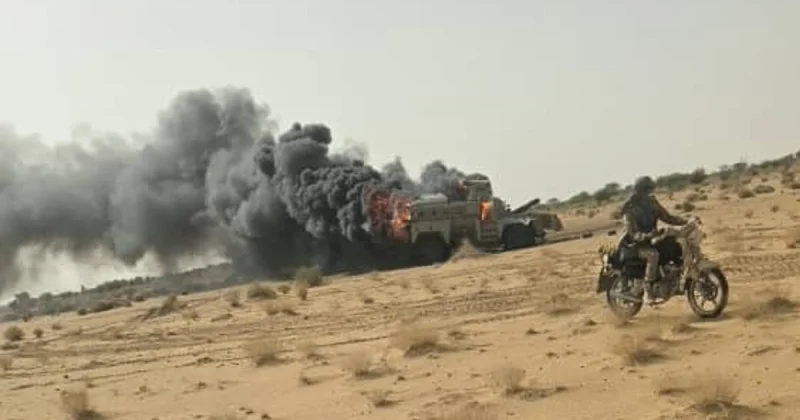
An ambush near Anefis on July 18 killed at least 50 Malian soldiers and hit a joint convoy of the Malian Armed Forces and Russia’s Africa Corps, sharpening one of the deadliest blows to Mali’s military this year. The attack was jointly claimed by the Azawad Liberation Front and Jama’at Nusrat al-Islam wal-Muslimin.
The ambush matters now because it landed in the middle of a broader pattern: coordinated attacks were launched across several parts of Mali in April, and the fighting around Anefis shows those operations are not isolated. Africa Corps later released footage it said showed drone strikes targeting fighters involved in the ambush, while the Malian military said it launched counter-operations after the assault. The outcome of those counter-operations has not been made clear, but the scale of the attack has already forced a sharper look at the battlefield the government is facing.

Héni Nsaibia said the Tuareg-led separatists and JNIM are acting together because they share a common enemy in the Malian armed forces and their Russian partners from the Africa Corps. He said they are functioning as force multipliers for one another, pooling resources and mutualizing their efforts. That cooperation is notable because the two groups are not natural allies. The Azawad Liberation Front seeks greater autonomy or independence for northern Mali, while JNIM wants governance based on its interpretation of Islamic law across the region.
That friction has not stopped them from fighting on the same side. The military government abandoned the 2015 Algiers Peace Agreement, requested the withdrawal of the United Nations Multidimensional Integrated Stabilization Mission in Mali, and deepened military cooperation with Russia, leaving the conflict to harden into a new alignment around shared enemies rather than shared goals. Russia’s military presence in Mali is now represented by Africa Corps, which replaced the Wagner Group, and the attack near Anefis suggests that shift has not brought the stability Bamako wanted.
What happened in July is less a one-off raid than a warning that Mali’s armed groups can still combine across fronts and sustain pressure on strategically important positions. If that pattern holds, the government will be fighting not just separate insurgencies, but a battlefield partnership that has already proved it can kill at scale.
