


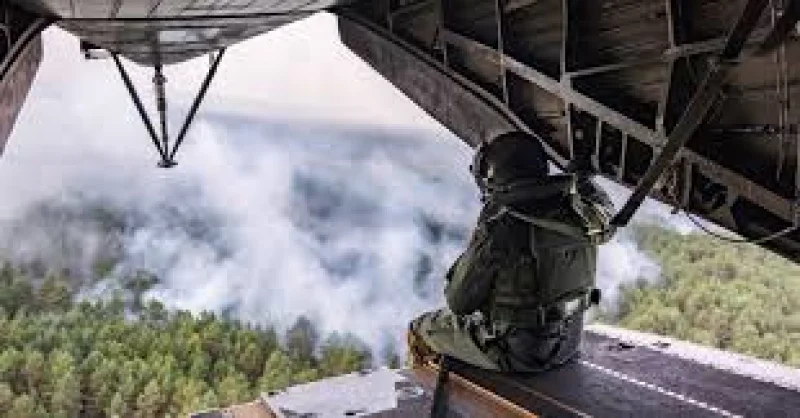
A fire in France's Fontainebleau Forest burned through 2,000 hectares and forced about 1,000 people to leave their homes as firefighters battled to contain a blaze that authorities said may have been deliberately set. The fire, which broke out on July 12, has drawn 850 emergency firefighters into one of the clearest signs yet of how fast Europe’s summer fires can overwhelm a landscape near Paris.
The scale is what makes the Fontainebleau Forest fire stand out. Firefighters said efforts to end it could take weeks, and that estimate matters because the blaze has already consumed 4,942 acres of woodland and spread across an area large enough to test emergency crews far from the usual image of remote southern fire zones. On July 16, Emmanuel Macron visited the firefighters’ central command site and shook hands with members of the drone section, a reminder that the fire is being managed as a national problem, not a local one.

France's Ministry of Agriculture says nine out of 10 wildfires are caused by people, and the heat gripping France and Spain has turned scrub and grassland into tinder in many places. That broader pattern helps explain why the emergency has moved so fast this month, with 32,000 hectares hit by fires since the start of July. It also explains why investigators are looking beyond the weather for answers in Fontainebleau Forest, where the first flames appeared in a former royal hunting preserve near Paris.
The friction in this blaze is that the usual explanation is not enough. Police said experts found ten ignition points spread over a little more than half a mile, a pattern that Laurent Nuñez said suggests a voluntary origin. That does not spell out every step in the inquiry, but it does point to something sharper than ordinary carelessness, and it lands in a country where fire rules, protected land restrictions and crowded woodlands make even small mistakes dangerous. Daniel Lacalle has argued that policies around nature restoration and building can make it harder in some cases to clear brush that piles up, adding another layer to a problem that is part regulation, part climate and part human action.
The result is a fire that now sits at the center of a wider European summer of flames. France and Spain have been among the hardest-hit countries since the beginning of the month, and the pattern is no longer just about record heat. In Fontainebleau Forest, the next question is not whether the fire was big enough to matter. It is how long it will take to bring it fully under control, and what investigators conclude about the ten points that made them think someone set it on purpose.
