


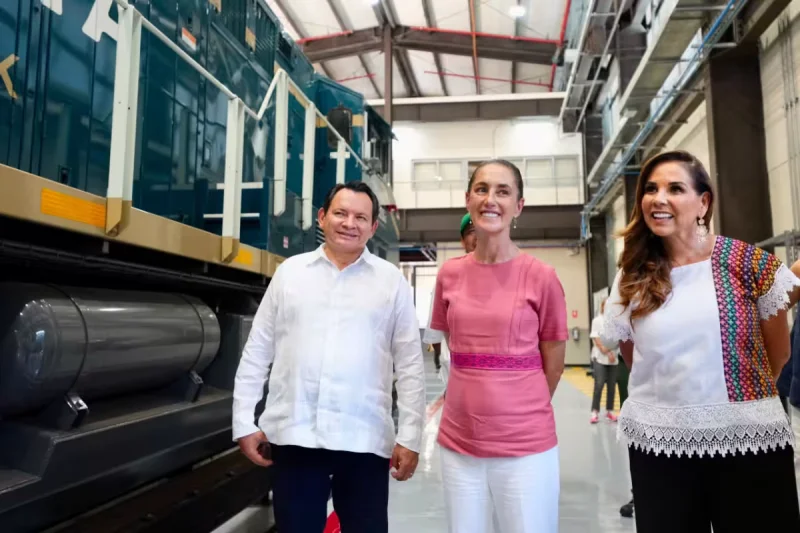
Claudia Sheinbaum Pardo said the first 12 locomotives of the Tren Maya de Carga have already arrived and are being used to move construction materials for the railway project. The announcement came during a meeting to review progress on the cargo line, turning a long-promised plan into a visible step forward.
For Joaquín Díaz Mena, who reviewed the project with Sheinbaum and governors from the southeast, the arrival of the locomotives matters because the line is meant to do more than move freight. He said the project will strengthen logistics connectivity and regional competitiveness, and it is being framed as a strategic asset for Yucatán and the wider southeast.

The cargo line is designed to link the region’s main industrial, agrofood, commercial and port hubs. In practical terms, that means lower transport costs, more room for new investment, and better conditions for local companies that need to move goods efficiently. It also carries a political promise that has been repeated around the project from the start: that infrastructure can become a source of jobs, not just a route between points on a map.
That promise is still ahead of the facts on the ground. The first locomotives are moving materials for construction, but no one in the meeting laid out when the Tren Maya de Carga will be fully operational or what milestone comes next. The project is advancing, yet its finish line remains out of view.
The evaluation meeting brought together officials from Yucatán, Quintana Roo, Campeche, Tabasco and Chiapas, along with Mara Lezama Espinosa, Layda Sansores San Román, Javier May Rodríguez, Eduardo Ramírez Aguilar, Gustavo Ricardo Vallejo Suárez, Manuel Jaime Ramírez Camacho, Ricardo Trevilla Trejo and Andrés Lajous Loaeza. For now, the signal is clear: the cargo line has entered a more tangible phase, but the question that matters most to the region is how quickly that movement turns into full service.
