


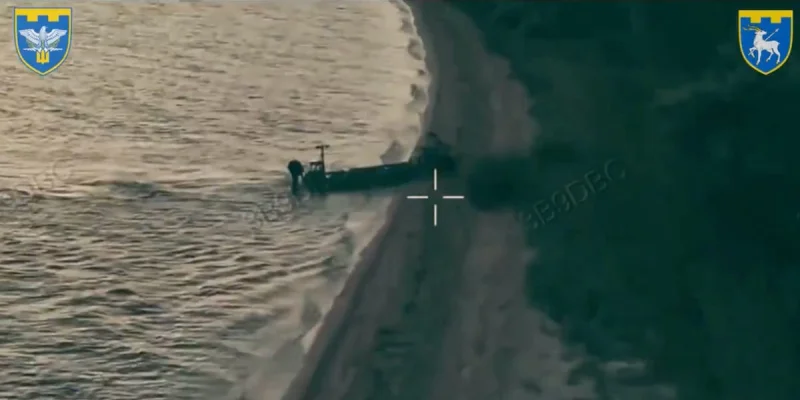
Ukraine said on Monday that it had carried out a robotic amphibious assault in which a naval drone carried a ground robot into Russian-occupied territory and set it down behind Russian lines on the Kinburn Spit. The military described it as the first known combat mission of its kind.
The operation unfolded on the Kinburn Spit, the narrow stretch at the end of the Kinburn Peninsula that lies directly west of Kherson. Ukrainian officials have long treated the area as strategically important because it helps Russian forces restrict access to the Black Sea, which helps explain why a test of this kind would matter now. The use of a robot in combat is not new for Ukraine. Naval drones have already been used against ships from the Russian Black Sea Fleet, and uncrewed ground vehicles have been sent on front-line missions that are too dangerous for human soldiers. In April, Ukraine said it cleared Russian-held territory using only ground robots and drones for the first time.

What made Monday different, at least in Ukraine’s telling, was the combination. The 123rd Separate Territorial Defense Brigade said it remotely guided a naval drone across the Black Sea to the coast, where it deployed an uncrewed ground vehicle armed with a mounted machine gun. Footage shared by the brigade on Telegram showed the machine gun firing shots at an unidentified target after the robot reached shore.
That is also where the story gets murkier. Ukraine did not identify which robotic platforms were used, what capabilities they had, or what the mission was meant to achieve. The brigade said only that the ground robotic complex was delivered to the enemy shore using an unmanned maritime platform, landed on occupied Ukrainian territory, and was used to accomplish a combat task. That leaves the central question unresolved: whether the assault was meant to probe defenses, hit a specific position, or simply prove that the chain of sea drone and ground robot can work under fire.
For Ukraine, the practical significance is immediate. The country has been pushing low-cost systems that can be deployed in large numbers even if some are destroyed, and the latest operation fits that logic as neatly as any battlefield demonstration can. If the account holds up, Monday was not just another robotic strike. It was a field test of a new combat path, one that starts at sea, ends on land, and could change how Ukraine thinks about getting machines into places soldiers cannot easily go.
