


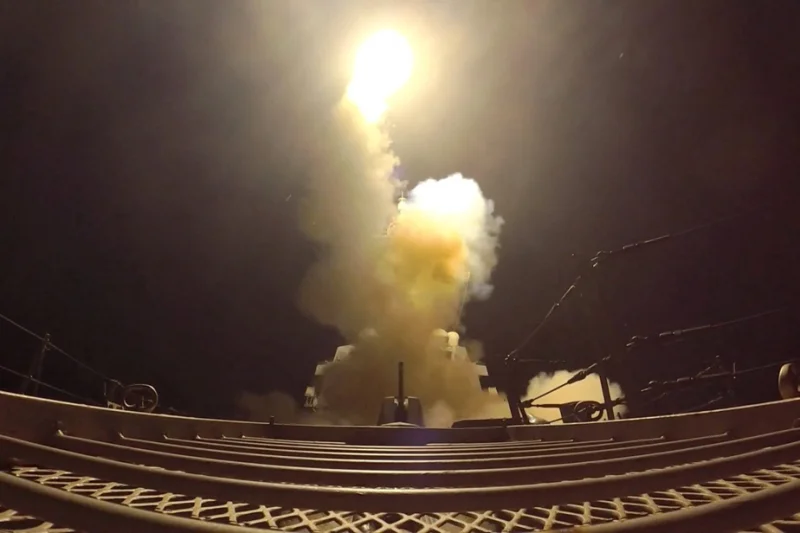
The United States bombed Iran for a second straight day on Monday, saying it had hit dozens of targets in a new series of strikes that began at 0 h 30 in Tehran and ended a little more than five hours later. CENTCOM said the attacks were aimed at Iranian air-defense systems, coastal radar, missile and drone capabilities, and small boats.
The timing matters because the fighting is now pressing directly on the Strait of Hormuz, a passage the U.S. military says it wants to keep open to protect civilian crews and commercial ships. Washington accuses Iran of hitting the GFS Galaxy in the strait over the weekend, while Oman said 23 crew members were rescued and one remains missing. The renewed violence and Tehran’s announcement of a new closure of the strait sent oil prices sharply higher Monday morning, underscoring how quickly this confrontation is reaching beyond the battlefield.

State media in Iran said the American strikes hit wide areas in the west and south of the country, including Qeshm island, Bandar Abbas and Khouzistan province. At Mahchahr, one strike killed at least one person and wounded four, according to a local official cited by Irna. Late Sunday, Irna had already reported one dead and two wounded on Farur island. That leaves the U.S. claim of precision under strain: the targets were military and maritime, but the damage being described by Iranian outlets is landing in places where civilians were still inside the blast radius.
Tehran’s diplomats “firmly condemned” the latest American bombing, even as the Revolutionary Guards said they had struck military bases in the Gulf used by the U.S. military in Jordan, Bahrain and Kuwait. Irna said the attacks reached Prince Hassan in Jordan, Ali al-Salem and Ahmad al-Jaber in Kuwait, and the American drone command center in Bahrain. Early Monday, air-raid sirens sounded in Bahrain and the Interior Ministry told residents to “go to the nearest safe place,” a reminder that this is no longer a distant exchange of fire but a regional one.
Sunday had already brought three missiles fired at Jordan, according to the army of the kingdom, and Monday’s sequence showed how quickly each side is answering the other. What remains unresolved is not whether the strikes happened — they did — but how far both sides are prepared to push this round, and whether the closure of Hormuz that Iran announced becomes a real shutdown or stays another threat made under fire.
