


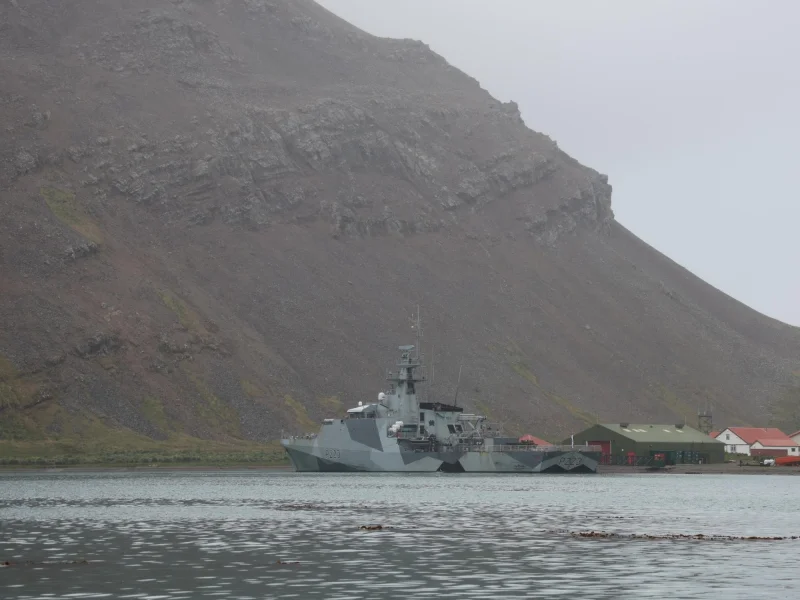
A week after the HMS Medway left the Malvinas for Punta Arenas, the Argentine Foreign Ministry was still preparing a response to a passage that passed through waters Argentina considers jurisdictional. The British patrol vessel, which the British side says was departing from the islands, has reopened a dispute that both governments know can turn fast.
The timing matters because Javier Milei and Pablo Quirno are already preparing the president’s long-awaited trip to the United Kingdom for Semana Argentina, a visit that could take place in London and no later than the end of October. In Buenos Aires, the delay in the reply has become part of the story: the government has been far quieter than in earlier Malvinas moments, even as the ship’s transit was being treated as a test of how far either side would push.
The HMS Medway is not just any vessel. It is a British military patrol ship assigned mainly to the Malvinas, Georgias del Sur and the Sandwich del Sur, and it replaced the HMS Forth in that role in January. That makes its route especially sensitive in a dispute that has never gone away, even after the United Kingdom won the war of 1982. In London, the British side said its military attachés had already warned Argentina that the ship was leaving the Malvinas, a version that clashes sharply with the one circulating inside the Argentine government.

That split has created the friction around the episode. The article refers to conflicting versions inside the government and between the government and the British side, with sensitive communications handled by WhatsApp. It also says the British and Argentine accounts of what happened are completely different, which leaves open the basic question of whether the ship’s passage was treated as a routine transit, a warning ignored, or something more deliberate. For now, the Argentine Foreign Ministry is still working on whatever repudio or declaration it plans to issue, but it has not yet closed the matter.
The wider backdrop is not only diplomatic but strategic. The incident lands as Navitas and Rockhopper were going to begin extracting oil in disputed Malvinas waters, and that alone is enough to sharpen every movement in the South Atlantic. The article also places the row alongside other signs of change, including Israel’s soon-to-open honorary consulate in Ushuaia and the role of Eyal Sela as the embassy’s representative in Argentina, all of which point to a region where old disputes are meeting new alignments. Argentina’s protest policy has varied by government, and past regional efforts to limit island-linked flags in ports have not been effectively enforced.
What happens next is narrower than the broader dispute, but no less revealing: whether the Argentine Foreign Ministry finally issues the response it has been preparing, and whether that response keeps the issue at the level of protest or turns the Medway passage into a fresh diplomatic fight. If the government chooses to lower the temperature, as Clarín put it, the real test will be whether both sides can keep the exchange there.
