


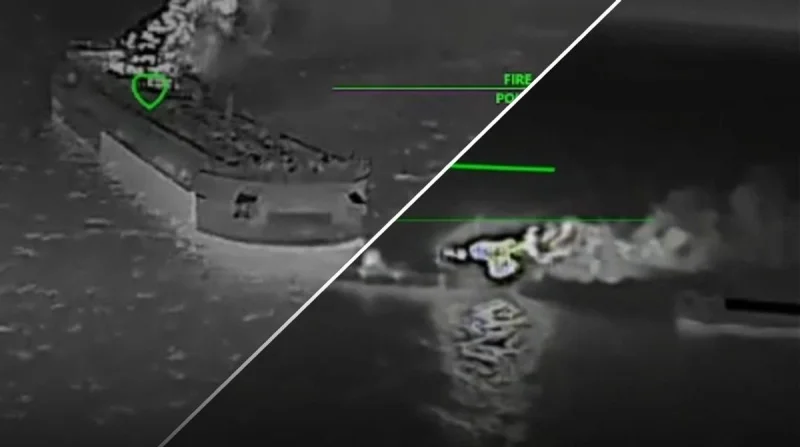
In early March, an American-made Shield AI V-BAT reconnaissance drone swept over Ukraine's Black Sea waters and helped spot Russian soldiers and military equipment on an oil rig near a gas field off the southern coast. Ukraine's navy then called in sea drones and opened fire, turning a surveillance flight into a strike that hit a key Russian platform for attacks into neighboring Ukrainian regions.
The engagement cost Russia over $1.5 million in military equipment losses, and it showed how quickly Ukraine is pairing long-range eyes in the sky with weapons at sea. The V-BAT's role matters now because Ukraine is using longer-range drones more aggressively while trying to keep pace after the United States stopped providing certain forms of intelligence for strikes inside Russia in March 2025.
That shift is visible across the campaign. In June, Ukraine nearly doubled its strikes more than 30 miles beyond Russia's front lines, according to Mikhailo Fedorov. On Tuesday night, Ukraine's military struck nine oil tankers in the Black Sea that were operating as part of Russia's shadow fleet. Last month, Russian officials suspended gas sales to civilians in Crimea, a reminder that the pressure is reaching deeper into infrastructure, not just military positions.

Negative, who described the V-BAT's work, said the drone's biggest advantage is its range. Because it can observe from far away, he said, it can confirm what is there, collect detailed imagery and provide intelligence without getting too close to the target. That makes it useful for expensive, strategically valuable or difficult-to-replace targets, the kind Ukraine has been trying to hit more often.
The catch is that the campaign still leans on outside help even as it widens. In January, Emmanuel Macron said two-thirds of the intelligence Ukraine receives now comes from France, and Taras Chmut said Ukraine has started to engage European countries more since the United States stepped back. Ukrainian manufacturers have also extended the range of their own surveillance aircraft by equipping them with Starlink terminals, a sign that Kyiv is trying to rebuild the intelligence pipeline as it pushes harder against Russia.
Volodymyr Zelenskyy has declared a 40-day influence operation that expires in early August, setting up the next test for a force that is trying to strike farther, see farther and rely less on Washington at the same time. Mikhailo Fedorov put the goal bluntly: Crimea, he said, will be turned into an island.
