


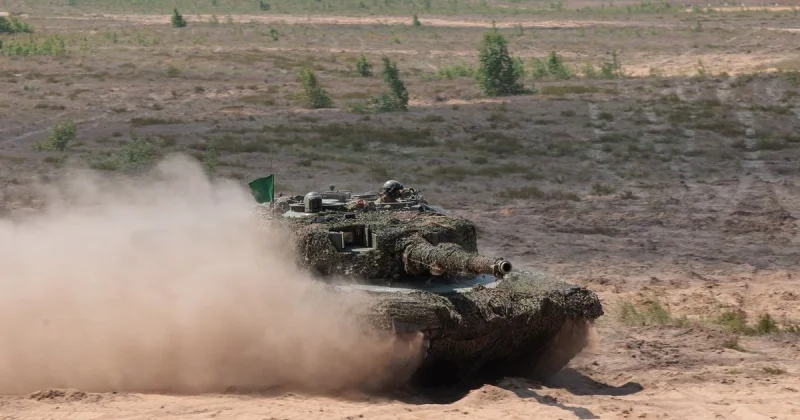
Germany’s 45th tank brigade spent a month drilling along the Lithuania-Belarus border, training to be ready to fight “tonight” and to defend Vilnius and the Suwałki Corridor. The exercises were part of a much larger build-up that would turn the unit into Germany’s first permanently deployed force abroad since the Cold War.
The timing matters because the balance around Lithuania is shifting now. U.S. forces in the region are shrinking, while Germany is trying to show it can take on more of the conventional defense burden that Washington is increasingly asking Europeans to carry.
What the brigade was doing was not a symbolic visit. It practiced with the newest armored vehicles, artillery, drones and air-defense systems it will receive as its ranks grow from 1,600 to about 5,000 by the end of 2027. The Suwałki Corridor, which links the Baltic states with Poland, is seen as one of the most sensitive routes on NATO’s eastern edge, and the drill was built around the idea that the unit should be able to respond immediately if needed.
That is also why the deployment has become a test of German power in a way that goes beyond equipment. Sebastian Hagen said Lithuanians have shown German troops enormous gratitude and added: “What we are doing now is what all allies did for Germany throughout the Cold War. The eastern flank has shifted even farther east, and now it is Germany’s turn to repay that.”

But the build-up has a problem that no amount of ceremony can hide. Germany is strengthening its forces near Lithuania, yet it is struggling to attract enough volunteers, according to the publication. The army may have modern hardware and a clear mission, but it still needs people to fill the formation that is supposed to grow to 5,000 troops.
There is also the question of what replaces the American presence that just left. The U.S. Army’s 1st Battalion, 12th Cavalry Regiment had been trained in the same area for months before it, along with the rest of the brigade stationed in Poland, was pulled from the region in June. European countries do not yet know whether another American unit will take its place.
That uncertainty sits behind the larger NATO debate. Hastings Lionel Ismay once described the alliance’s purpose as “to keep the Russians out and the Americans in,” but the current direction points somewhere else. Under the idea sometimes called NATO 3.0, Europeans are expected to take the lead on conventional defense while Washington provides the nuclear umbrella. Germany says it intends to spend 3.5 percent of gross domestic product on defense by 2029, and the publication says that by the end of the decade it could spend more on its armed forces than the United Kingdom and France combined.
For Lithuania, the meaning is immediate. A German brigade training to defend Vilnius and hold the Suwałki Corridor is a sign that Europe is trying to take more responsibility for its own security even as the U.S. role fades. The unanswered issue is whether that shift will arrive fast enough to replace what was just withdrawn, or whether the region will have to sit with a thinner American shield while Germany is still trying to build its own.
