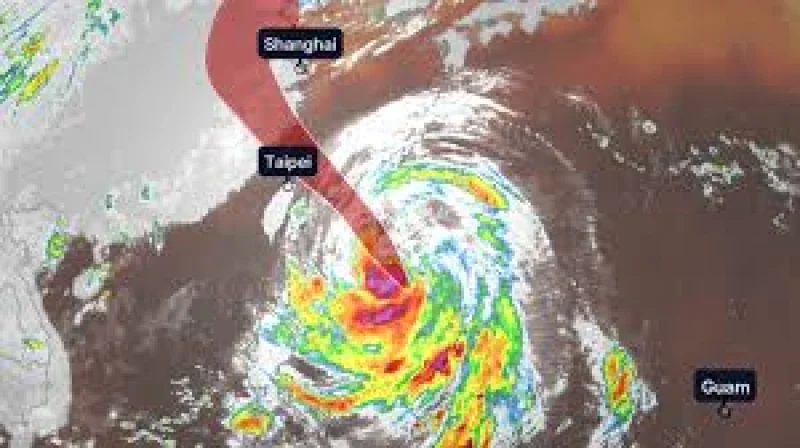
Typhoon Bavi is pushing northwest across the western Pacific Ocean after slamming Guam and the U.S. Northern Mariana Islands with Category 5 force, and forecasters now expect the storm to brush Taiwan and then move into eastern China late this week. The system was still more than 300 miles south of Okinawa as it tracked on, but it had already left a hard mark on the islands in its path.
On Rota, Bavi came ashore at 9 a.m. local time Monday, which was 7 p.m. EDT Sunday, with peak sustained winds in the eyewall near 180 mph. Widespread damage was reported there and across Guam, Saipan and Tinian. A water distribution station near Rota's airport suffered structural damage. Power poles and lines were downed and bent at the airport, and a wood structure with a tin roof was reportedly destroyed.

The wind field was strong enough to reach beyond the worst of the eye. Gusts of 111 mph were clocked at Saipan International Airport and at the National Weather Service in Guam, while Tinian reported a gust to 94 mph. Guam International Airport picked up 15.68 inches of rain on July 4 and July 5, including more than 12 inches on July 5 alone. In Guam, heavy rain and storm surge flooded numerous roads, and rocks and debris left lanes of Route 1 impassable, according to the National Weather Service.
Bavi first became a tropical storm on July 1, then rapidly strengthened into a typhoon on July 3 before becoming a super typhoon later that day. It has since started to weaken as it moves over less warm water and into stronger wind shear, but it is expected to stay a typhoon until landfall in China. That forecast matters because the storm has also grown larger, which means a broader stretch of Taiwan and eastern China could still see tropical-storm-force gusts by Friday and Saturday even if the center does not strike every place directly.
The next stretch of the track is the one to watch. Bavi could first pass over southwest Japan's Sakishima Islands Friday night, close to at least parts of Taiwan on Saturday and then reach parts of eastern China, including near Shanghai, Saturday night as a minimal typhoon or tropical storm. Typhoons are what hurricanes are called in the western Pacific Ocean north of the equator, the planet's most active zone for tropical cyclones, where the season often produces 25 to 26 tropical storms and 16 typhoons in an average year. For people under Bavi's path, the question now is not whether the storm will fade, but how much strength it will have left when it arrives.