


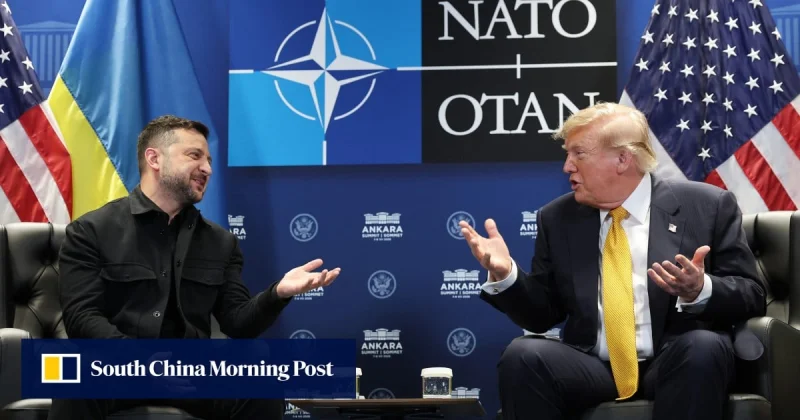
Donald Trump used the NATO summit in Turkey on Wednesday to deliver a blunt warning to allies: he said NATO had failed two key tests, one involving Greenland and another involving Iran.
He told reporters he was “really testing” NATO and wanted to see whether world leaders would be there, a line that turned what was supposed to be a show of allied cooperation into a public stress test. Trump said he was not happy with NATO because of what it did with Greenland and because members were unwilling to help the U.S. with what he called the No. 1 state sponsor of terror, Iran.
The remarks landed at a summit where Trump was already pressing a familiar grievance. He said Greenland should be controlled by the United States, not by Denmark, and repeated that Denmark does not spend money to really help Greenland. He also said Greenland matters for protection of the world, not just the United States, and described the island as surrounded by China ships and Russian ships.

That gives the comments a sharper edge than a routine complaint. Trump was not only criticizing NATO; he was saying he had set a test for the alliance and did not like the answer. He said members were unwilling to help the U.S., a statement that leaves open which NATO countries he had in mind but makes clear he sees the alliance as falling short when American and broader security interests collide.
The backdrop is a longstanding fight over Greenland, which is backed in defense, foreign affairs and monetary policy by Denmark, even though Greenlanders are officially citizens of Denmark. The island also plays a critical role in U.S. missile warning systems and Arctic defense, while China and Russia have expanded their presence in the region. Trump had previously proposed buying Greenland from Denmark multiple times, but this week he chose to bring the issue into the summit itself.
For NATO, the immediate problem is that Trump has turned a meeting built around allied coordination into a public exam, and he is the one grading it. What he does next matters less than the signal he already sent: in his view, the alliance still has to prove it will stand with the United States when the pressure is real.
