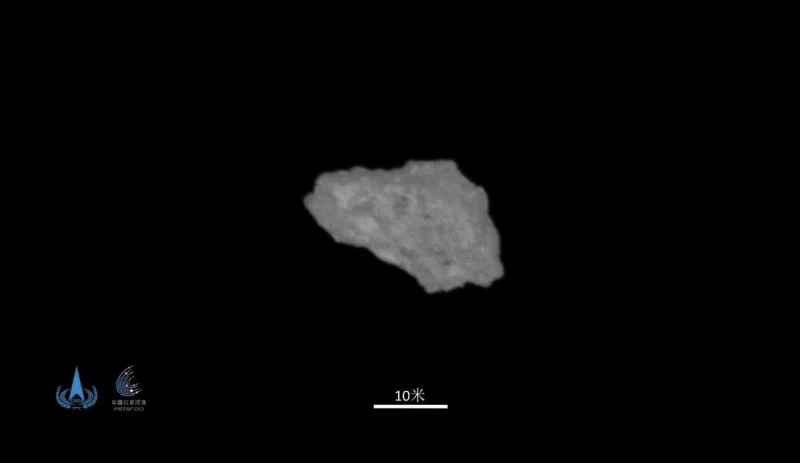
China's Tianwen-2 spacecraft has sent back its first image of Kamo'oalewa, the Earth quasi-moon it reached after roughly 400 days in flight. The picture marks the mission's first hard look at the asteroid since launch and the clearest sign yet that the sample-return effort is moving ahead.
Claire Cameron, writing from New York City, was among the reporters following the milestone because Kamo'oalewa sits in a strange place in the solar system and in the science around it. The small body is a quasi-satellite that orbits the sun while staying close to Earth, coming as near as 9 million miles and as far as 25 million miles away. Astronomers have identified eight such space rocks that seem to follow Earth's path, and some scientists call them Earth's mini moons or quasi moons.
The new image matters because it comes after a long trip that Tianwen-2 covered in about 621 million miles. The spacecraft launched on May 28, 2025, to retrieve samples from Kamo'oalewa, which is only about 66 feet across and spins once every 28 minutes. In late June, the China National Space Administration said the probe had reached a distance of 12 miles from the asteroid and was preparing for more detailed work.

That work is expected to probe the asteroid's morphology, material composition and internal structure before any sample collection begins. The agency said the probe will progressively conduct more detailed scientific exploration to acquire data on those features, laying the groundwork for the next phase of the mission. For now, the first image is the proof that Tianwen-2 is close enough to start turning a distant target into a measured object.
Kamo'oalewa is also a scientific argument in its own right. Research suggests it may be a stray piece of the Moon blasted into space by an ancient impact, but other evidence, including observations from the James Webb Space Telescope, has cast doubt on that idea. The image does not settle that dispute, yet it gives mission scientists a closer view of a body that could help answer it.
Tianwen-2 is scheduled to bring samples back to Earth in 2027, dropping them into the atmosphere during a flyby before continuing on to 311P/PanSTARRS. The next phase will matter most if the samples confirm that Kamo'oalewa is linked to the Moon, because that would turn a curious near-Earth object into a direct piece of planetary history.