


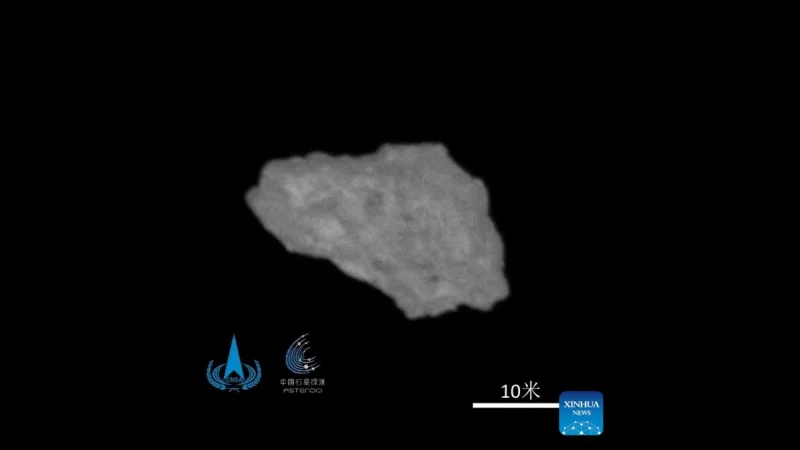
China's Tianwen-2 probe has sent home the first photo of Kamo'oalewa, the quasi-moon it reached for an asteroid sampling mission. The image, taken on July 2, shows the object as a small, uneven rock and marks the start of a close-up campaign that will end with an attempt to bring material back to Earth.
The picture matters because Kamo'oalewa, formally known as asteroid 2016HO3, is not a large body drifting far from Earth. It is only about 50 to 65 feet across, and Tianwen-2 is now working from a safe distance of about 12 miles after traveling 620 million miles to get there. For readers searching the term quasi-moon today, this is the first real look at a target that has stayed close to Earth while circling the sun in a less stable path than the planet's true moon.

Tianwen-2 launched on May 28, 2025, atop a Long March 3B rocket from Xichang spaceport in southwestern China. Just over a week later, China's space agency released an image the probe had beamed home when it was 1.8 million miles from Earth, a sign the spacecraft was working normally before the mission turned to its asteroid target. The new photo is the sharper payoff: a close view of the body the probe will study for nearly a year with 11 scientific instruments before trying to collect a sample from its surface.
That sample attempt carries the larger scientific bet. Some scientists think Kamo'oalewa may not be a typical asteroid at all, but a piece of the Moon blasted into space by a massive impact between 1 million and 10 million years ago. A 2024 study in Nature Astronomy tied that idea to Giordano Bruno crater, though the object's origin is still not known. Earth has at least seven known quasi-satellites, but Kamo'oalewa stands out because its story could connect a near-Earth object to the Moon itself.
China is entering a field with only two precedent missions to point to. Japan's Hayabusa returned material from asteroid 25143 Itokawa in 2010, and the United States later did the same with OSIRIS-REx, which snagged material from Bennu in 2023. Tianwen-2 is China's first asteroid sample attempt, and if the probe preserves enough material after collection and return, it could turn one blurred rock near Earth into a direct test of where it came from.
