


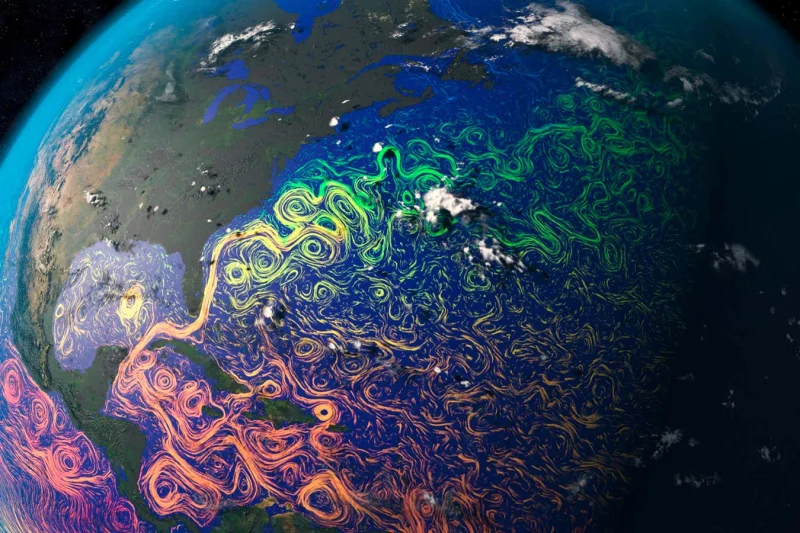
A major Ocean current system that helps move warm water north in the Atlantic may be closer to a tipping point than scientists thought, with new research saying the slowdown could begin affecting weather in the late 2030s or 2040s. Stefan Rahmstorf, who has spent 30 years studying the Atlantic Meridional Overturning Circulation, said the AMOC shutdown is not a low-probability event anymore.
The finding matters now because Rahmstorf said the team feels more confident than ever that the AMOC may reach the tipping point by the middle of the century and could collapse or shut down by 2100. He said impacts are already going to be felt in the next few decades unless carbon emissions are cut very fast, a warning that makes the current moment more than an academic debate.
The AMOC is a vast system of ocean currents that carries warm, salty tropical water toward the North Atlantic. As that water cools, it becomes dense, sinks and flows back south at deeper depths. Scientists have known for years that it is weakening, but the latest research suggests a more abrupt deceleration than many climate models had projected. Another study published in April pointed in the same direction, indicating a sharp decline of roughly 50 percent by the end of the century.

One of the clearest clues is a cooling patch of ocean just south of Greenland and Iceland. That area has cooled over the last century even as much of the world’s oceans have warmed, and scientists call it the Atlantic cold blob or warming hole. The latest research argues that the cooling is not just the result of sea surface heat loss or changing winds and cloud patterns. It is tied to a weakening AMOC, which means the signal is not a local oddity but a sign that the circulation itself is changing.
That link helps explain why the cold blob has drawn so much attention. Climate change has disrupted the North Atlantic temperature and salt balance through warming seas, melting ice and increased rainfall, and other researchers have explored how the cold blob connects to altered atmospheric circulation and even heat domes over Europe. Gerard McCarthy said that cold is not a kind of get-out-of-jail-free card for global warming, because some hot extremes can actually be worsened by the cold blob in the Atlantic.
For people in New England and across the Atlantic Basin, the worry is not a distant ocean chart but a shift that could reshape weather patterns while the century is still young. The unanswered question is how fast emissions fall from here, because the new work suggests the window to avoid the most serious AMOC impacts may be much shorter than earlier models implied.
