


Russia has lost the military initiative in Ukraine as the costs of Vladimir Putin’s war keep rising, and a new estimate from the Center for Strategic and International Studies says the Russian military has now suffered 1.4 million battlefield casualties and as many as 450,000 deaths since February 2022.
That scale of loss lands in June 2026, after a spring in which Russian forces lost more ground than they captured in both April and May and finished those two months with a net loss of roughly 400 square kilometers. It also comes as the war is still being searched for in the same place it has been grinding for months: whether Russia can keep feeding men into the front fast enough to hold what it has taken.
The numbers point in one direction. Russian monthly casualty rates were over 30,000 per month in 2026, while recruitment ran at roughly 27,000 new recruits per month. That gap matters because casualties and recruitment are not abstract counters; they are the machinery of whether an army can replace itself. CSIS puts the Russia-Ukraine casualty rate at nearly 8:1 in the first half of 2026, a sharp break from the 2:1 to 3:1 ratio that held for much of the war.

On the ground, the offensive has largely stalled around Kostiantynivka, Pokrovsk and Sloviansk, where advances have slowed to about 50 meters per day, 70 meters per day and 90 meters per day, respectively. Those are not the numbers of a force breaking through. They are the numbers of one that is spending heavily to move barely at all. That is why the spring losses matter so much: when Russia gives up more ground than it gains, even a small net loss can signal a larger shift in momentum.
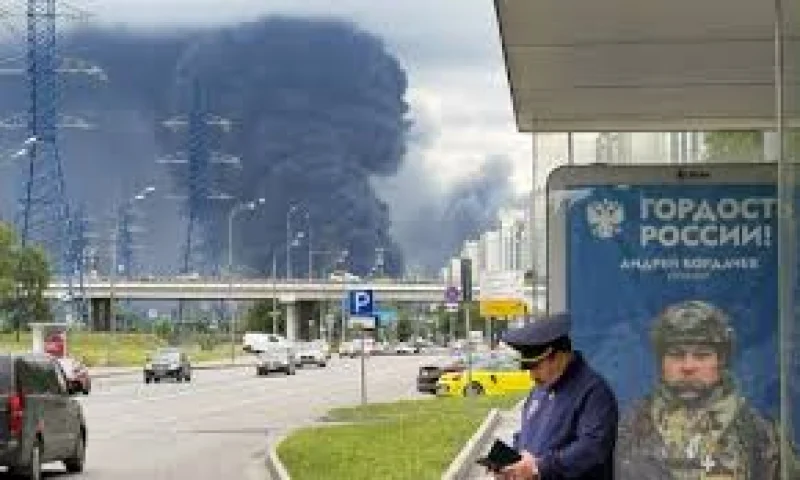
Putin has already shown he knows the war is bleeding into the home front. He dramatically scaled back his annual military parade in May 2026, a quiet acknowledgment of concern about Ukrainian long-range strikes. Ukraine has been hitting Russian military and economic targets with short-, medium- and long-range attacks, using AI-enabled systems in what CSIS describes as a new approach to air power. Major cities such as Moscow and St. Petersburg have come under attack, and Crimea has faced withering strikes that have disrupted fuel supplies and caused electricity outages.
The unanswered question is not whether Russia is paying a high price. It is whether Moscow can keep paying it. If casualty rates stay above recruitment, and if spring’s territorial losses continue beyond May 2026, the war moves from attrition to erosion — and the side with the larger army begins to look less certain of being able to use it.
