


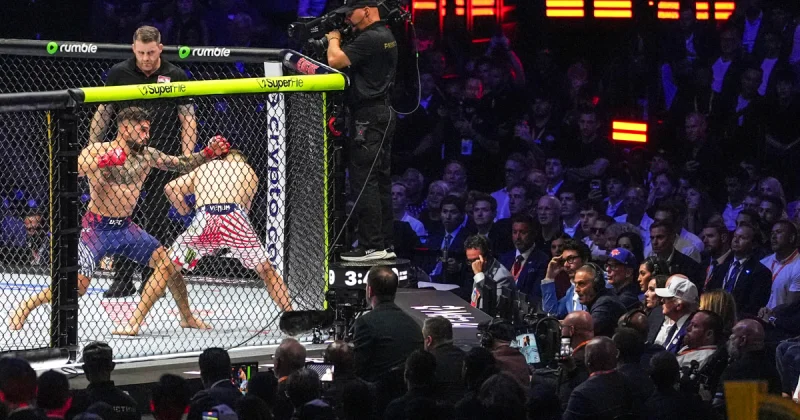
Kash Patel disclosed details on social media about arrests in an alleged White House UFC plot on 16 June, before the Justice Department had formally announced the case. His post said five men suspected of planning to attack the event with drones and explosives had been “stopped cold.”
The timing matters because the post landed while the case was still active. Hours later, the Justice Department said it had arrested five men for allegedly conspiring to “plan and execute a mass casualty event,” and two more men have since been arrested and charged.
Patel framed the operation as routine success, praising “the rapid action of the FBI, our partners, and the Department of Justice in a multi-state operation.” But several law enforcement officials involved in the case said the investigation was still ongoing when he published it, and agents were still searching for additional suspects.

That is where the problem starts. The inquiry was sealed by a court order, and under US federal law there is a general ban on publicizing information tied to sealed cases while that order remains in force. Formal court authorization would be needed to reveal contents of a sealed case, which is why the public disclosure sat uneasily beside the fact that investigators were still trying to build the case without tipping off anyone else who might be involved.
Matt Quinn, who said he had a 29-year career, made the tension plain. “I’ll tell you a phrase I learned early in my career in the New York field office and that’s ‘Don’t choke on your own smoke,’” he said. Quinn added that “The Secret Service led that investigation from the beginning,” that “I’ll tell you that case is ongoing,” and that “In order to maintain the integrity of the investigation and the security plan, we chose not to leak it.”
The result is a rare collision between a public post and a sealed case. Patel was free to celebrate arrests once the government moved to announce them, but he posted first, while the inquiry was still under court restraint and before officials said the full scope of the alleged plot had been cleared.
Patel has also previously cited court orders sealing grand jury testimony when defending the FBI’s inability to release many of its files on Jeffrey Epstein. That makes this disclosure harder to dismiss as a simple slip: the question now is whether a senior official who has invoked secrecy as a shield elsewhere crossed the line by talking too soon here.
