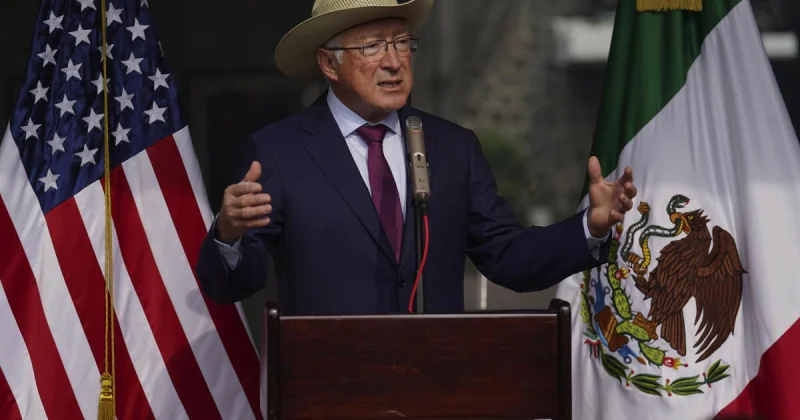
Ken Salazar has put a stark allegation about Andrés Manuel López Obrador into print just as it is set to reach readers next month: that Mexico’s former president feared Ismael “El Mayo” Zambada would spill the beans on corrupt Mexican officials after his July 2024 arrest outside El Paso.
The memoir, Borderlands: My Fight for an Inclusive America, is scheduled for release next month by BenBella Books, and the claim lands in the middle of renewed scrutiny of Mexico’s political class and its dealings with organized crime. Salazar says the arrest prompted López Obrador to worry that the cartel boss might speak to U.S. prosecutors about Mexican authorities in cahoots with organized crime.
Salazar said in a telephone interview that he had never seen evidence tying López Obrador to Mexico’s cartels. “I never saw any proof of it,” he said, adding that López Obrador strongly believed in Mexico and the sovereignty of Mexico. That caveat sits at the center of the dispute: he is not saying he proved corruption, only that a fear of exposure existed after Zambada was taken in July 2024.

The source Salazar says informed him was an unidentified figure he called “the AMLO whisperer.” Salazar wrote that “the Whisperer” told him López Obrador “is very concerned about the information the United States will get from El Mayo.” On Monday, Claudia Sheinbaum rejected the idea that her predecessor was worried about Zambada’s testimony, saying, “There was no worry about” what he would tell U.S. prosecutors and arguing instead that López Obrador was concerned about U.S. meddling in Mexico.
Salazar said the fallout was personal as well as political. He said he was frozen out after Zambada’s arrest and never spoke to the president again, becoming a persona non grata in Mexico City before he resigned after the election of Donald Trump. López Obrador later issued a statement accusing the Trump administration of using a narco-terrorism “pretext” to weaken Mexico’s left, a charge that sharpened the argument around the memoir far beyond one diplomat’s recollection.
The dispute now enters public view at a delicate moment, with Mexican, U.S. and Canadian officials negotiating revisions to the regional free-trade agreement. Salazar’s account gives critics and allies alike new material, but it also leaves the hardest question unanswered: if he never saw proof tying López Obrador to the cartels, how far did the fear of exposure actually reach inside Mexico’s power structure?