


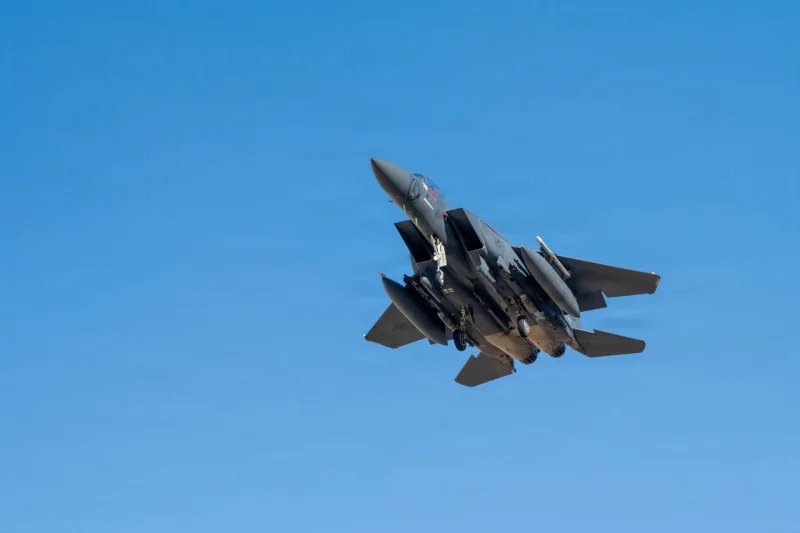
A U.S. F-15E Strike Eagle pilot shot down over Iran reportedly saw a bizarre drone formation that looked like a jellyfish just before ejecting, and the account has now become part of a wider intelligence debate over what brought the jet down. The pilot’s description, shared after his rescue, is drawing attention because early assessments suggested the drones may have played a role in the shootdown.
The pilot said multiple Iranian drones were hovering and moving together, with smaller drones beneath larger ones like legs. One source familiar with the account described it as “real alien sh*t,” while another called it a “minefield of drones.” That is the detail driving the search interest now: not just that a fighter was hit over Iran, but that it may have been facing a coordinated aerial pattern moments before impact.
He was rescued by U.S. special forces hours after ejecting, and the weapons systems officer later evaded capture in mountainous terrain for more than a day before being recovered. The sighting was reportedly shared with U.S. intelligence officials during a post-rescue debriefing, giving analysts a first-person account from inside a combat loss rather than a distant radar track or poststrike assessment.

That account has not settled the question of what actually happened. Intelligence officials have debated how to interpret it and whether the pilot could clearly recall the incident after suffering a concussion in the crash. It also remains unclear whether the second crew member saw the drones at all, leaving the formation vivid but incomplete as evidence.
What made the report stand out is the possibility that the drones were operating in a way U.S. intelligence had not previously assessed Iran to possess. Sources said the capability described by the pilot resembles one-to-many meshed networking, a method in which multiple drones move as a coordinated system rather than as independent aircraft. In practical terms, each drone can help relay commands and maintain spacing, so the group behaves more like a single network than a loose swarm.
That is why the report matters beyond one downed jet. Emma Bates said advanced drone swarms that can hold coordinated formations could sharply improve military effectiveness and create new problems for air defenses. Officials have also examined signs of Iranian cooperation with China and Russia on drone technology, adding another layer to the intelligence review now underway.
The exact cause of the aircraft’s downing remains under investigation, and the report does not prove the jellyfish-like formation brought the jet down. But it has opened a sharper question: whether the fight over Iran is already testing drone coordination techniques that air defenses are only beginning to understand. Washington and Tehran are still negotiating after last week’s 60-day ceasefire window, which makes any hint of a new battlefield capability more than a historical footnote.
