


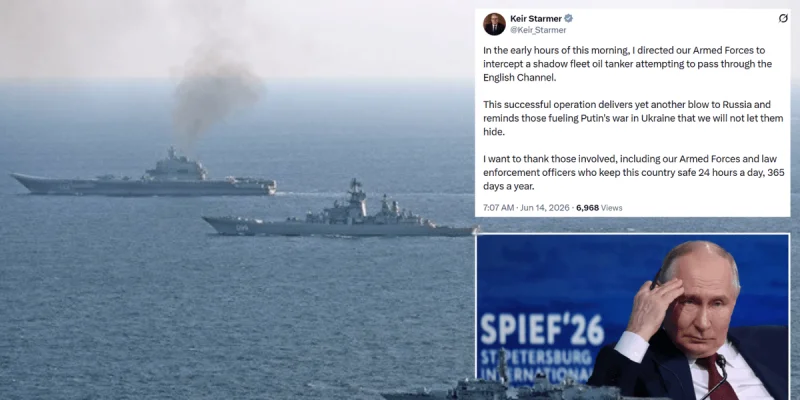
British armed forces boarded the Russian shadow fleet oil tanker Smyrtos in the English Channel early on Sunday morning, then held it under watch as investigators continued their work off the south coast of England. The six-hour operation put Royal Marine Commandos, National Crime Agency officers and military assets into one enforcement move aimed at a vessel the UK treats as part of Russia's oil network.
The timing matters because the government had already said in March that British armed forces could board sanctioned vessels passing through UK waters, and this was the clearest use of that power so far. Starmer said the successful operation delivers yet another blow to Russia and reminds those fuelling Putin's war in Ukraine that we will not let them hide.
The scale behind that judgment is large. The MoD says Russia's shadow fleet is made up of over 700 vessels and carries 75% of Russia's sanctioned oil, while the UK says it has sanctioned more than 500 vessels and banned them from entering its ports or receiving British financial, insurance or brokerage services. In practical terms, that means the government is not only trying to stop ships from docking; it is trying to cut off the commercial support that keeps the trade moving.
Smyrtos was not stopped by chance. According to MarineTraffic, it sailed under a Cameroon flag and was at anchor in the English Channel, a detail that sits uneasily beside the UK's decision to treat it as part of Russia's shadow fleet. The operation was conducted in close co-ordination with the French and backed by the RAF, a British helicopter, Maritime Air Group aircraft, an RAF P-8 aircraft, HMS Sutherland and HMS Ledbury.
That friction is the point. A vessel can fly one flag and still be treated as part of a sanctions-evasion network if the evidence links it to Russian oil, and the government has made clear that it intends to press that case under international law. Richard Hermer said the government would pursue Russia's shadow fleet under the full force of international law, and the result on Sunday suggests the UK is prepared to use military and law-enforcement power to test that promise at sea.
The immediate next step is simple enough: Smyrtos stays held and monitored off the south coast of England while investigations continue. The bigger question is whether the boarding of one tanker becomes a template for more such seizures, especially after the French said on 1 June that their military had intercepted a sanctioned tanker suspected of being part of Russia's shadow fleet with UK support.
