


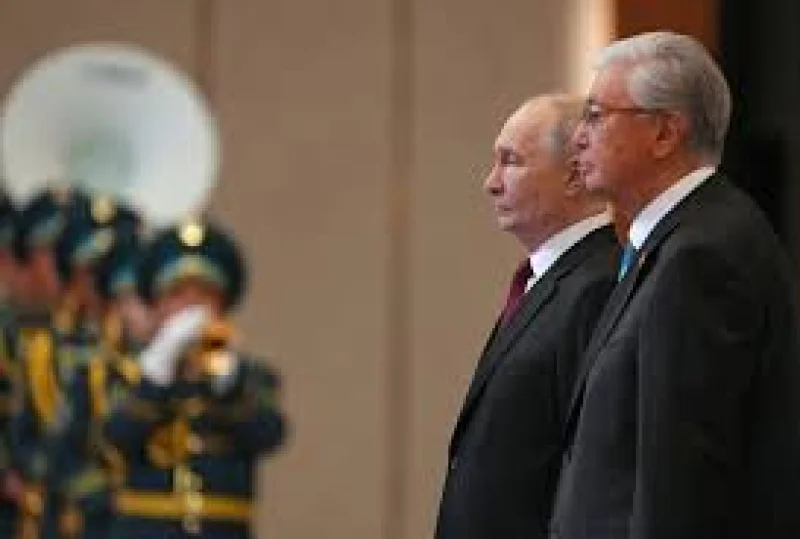
Russia and Kazakhstan signed a $16.5 billion agreement on Thursday to build Kazakhstan’s first commercial nuclear power plant, a project meant to steady a power system that has long leaned on aging coal plants and still faces electricity shortages. The deal was sealed in Astana during high-level talks between Vladimir Putin and Kassym-Jomart Tokayev.
Under the agreement, a Russian export loan will cover roughly 85% of the cost, and Rosatom will lead construction near the village of Ulken in southeastern Kazakhstan, on the shores of Lake Balkhash. Kazakhstan’s atomic energy agency said the facility will include two advanced VVER-1200 Generation III+ reactors, making it one of the country’s most important energy projects to date.
Tokayev said at the signing ceremony that “the agreement signed today on the construction of the Balkhash NPP has an important role.” Putin called it “a flagship project in the field of peaceful nuclear energy,” and said the plant would make “a significant contribution to the energy supply of the Kazakh economy, helping to provide businesses and households with affordable and clean energy.” He also said the two countries were “talking about the creation of an entire industry, including education, personnel training, and so on.”
The deal matters because Kazakhstan has spent more than two decades struggling with old coal-reliant power infrastructure and electricity deficits, even as it remains the world’s largest producer of uranium, according to the World Nuclear Association. For Astana, the plant is meant to bring long-term domestic supply stability. For Moscow, it adds a high-profile win at a time when the Kremlin is working to preserve economic and geopolitical influence across former Soviet states despite Western sanctions.
Rosatom beat China National Nuclear Corp., France’s EDF and Korea Hydro & Nuclear Power for the main construction mandate, putting Russia at the center of a project that is both technical and political. The agreement points to more than just a power station: it ties Kazakhstan’s future energy planning to Russian financing, Russian engineering and, if Putin’s remarks are any guide, Russian training and industry-building as well.
That leaves the key question not whether Kazakhstan will get its first commercial nuclear plant, but how much leverage the project gives Russia once construction begins. With the financing, the reactors and the lead contractor now chosen, the next phase will show whether the Balkhash project becomes a fix for Kazakhstan’s power gap or another long-term dependency wrapped in an energy solution.
