


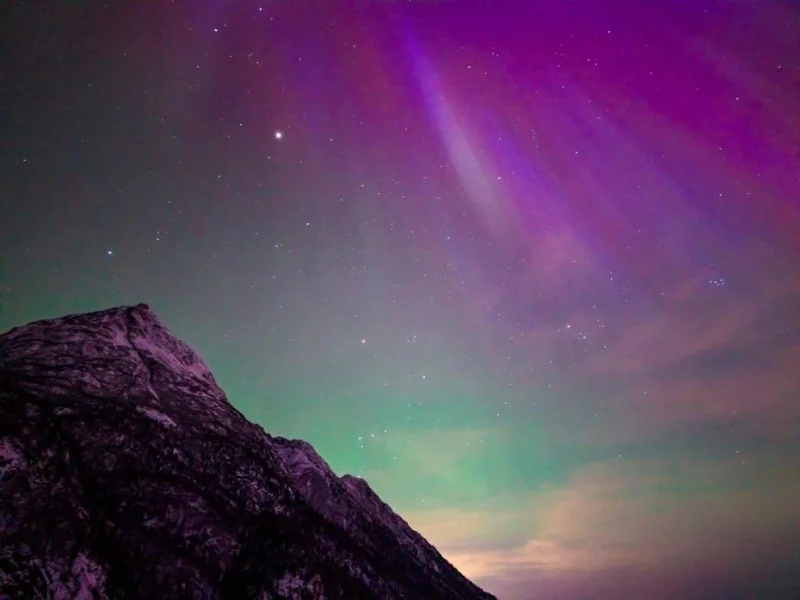
The northern lights could glow across several states along the U.S.-Canadian border on Sunday night after NOAA forecast a Kp index of five out of nine and tracked a coronal mass ejection that escaped from the sun on Saturday. The best chance is still north of the border, but people in the Lower 48 may get a rare look if the sky and storm conditions line up.
That is why the forecast is drawing attention now. NOAA says the aurora has a chance of visibility in most states along the border, including North Dakota, much of the Michigan Upper Peninsula, northern Minnesota, northern Montana and the northernmost stretches of Washington, Idaho, Wisconsin and South Dakota. The agency also gives Alaska a high chance of seeing the aurora borealis Sunday night, underscoring how much better the odds are there than farther south.
The timing is tied to the solar blast itself. Forecasters expect the coronal mass ejection to arrive by Monday, when NOAA is predicting minor to strong geomagnetic storms that could last through Tuesday. Those storms matter because coronal mass ejections are bursts of solar material from the sun’s outer atmosphere, and when they slam into Earth’s magnetosphere they can shake loose the conditions that make the northern lights visible. Stronger storms can push the aurora farther south than usual, with NOAA saying it can reach as far as Illinois.
There is still a limit to how much of the map lights up. NOAA says the chance of visibility in the Lower 48 is relatively low compared with Alaska, even though the aurora could be spotted in multiple border states. That leaves a narrow window for skywatchers in the northern tier: enough activity for a show, but not enough certainty to call it a lock.
For anyone trying, NOAA recommends heading north toward Earth’s magnetic north pole, finding a spot with a clear view of the northern sky and staying away from city lights. The best viewing is typically between 10 p.m. and 2 a.m., which gives the northern lights their strongest shot at breaking through on Sunday night before the solar disturbance is expected to arrive on Monday.
The unanswered question is how hard the storm will hit once it gets here. A Kp index of five signals a notable aurora chance, but the real test comes Monday and Tuesday, when NOAA will be watching whether the incoming coronal mass ejection produces only minor geomagnetic activity or something stronger that widens the display even farther south.
