


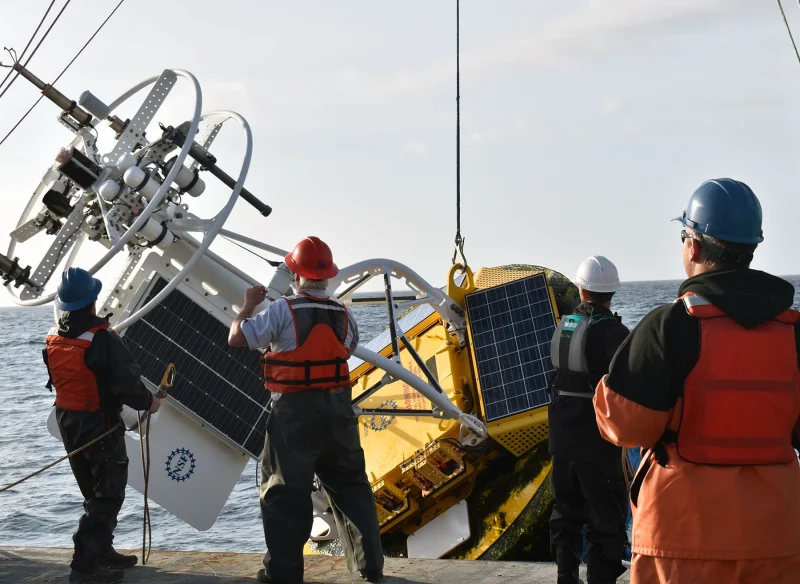
The U.S. National Science Foundation is moving to remove hundreds of ocean monitoring instruments from four sites in the Atlantic and Pacific, starting with the Endurance Array off Oregon and Washington, where the descoping process has already begun and is expected to be finished this month.
That is the immediate shift that is driving searches for the ocean observatories initiative now: a large observing network that has been measuring climate variability, biogeochemical cycles, marine food webs and coastal dynamics is being pared back site by site, with the other three sites set for decommissioning in 2027.
Jim Edson, in a community update, said the Endurance Array descoping process had already started. The National Science Foundation told Woods Hole Oceanographic Institution on May 8 that it planned to adjust the scope of its support for select elements of the network, a move that would leave the network smaller even as it remains in service.

The scale of the cut matters because the Ocean Observatories Initiative is a $386 million network that was completed in 2016 and was originally expected to operate for 25 years. Scientists use its data to study ocean climate variability and its effects on the seas, including the Atlantic Meridional Overturning Circulation, making the loss of instruments more than a routine maintenance change.
Still, the agency says it is not cancelling the Ocean Observatories Initiative, and it says all previously collected data will remain available through the OOI Data Center. That leaves a narrower but still functioning system in place, even as Woods Hole Oceanographic Institution, which has designed, built, deployed and maintained the arrays since the start, prepares for the next round of reductions.
The backdrop is already lopsided. Two other arrays in the same network were discontinued during Donald Trump's first term: the Global Argentine Basin Array in the South Atlantic in 2018, after three years of data collection, and the Global Southern Ocean Array in 2020, after five years of use. What remains now is a network that was built for long-term ocean surveillance but is being trimmed in stages, with the Endurance Array due to wrap up this month and the rest of the removals still ahead in 2027.
