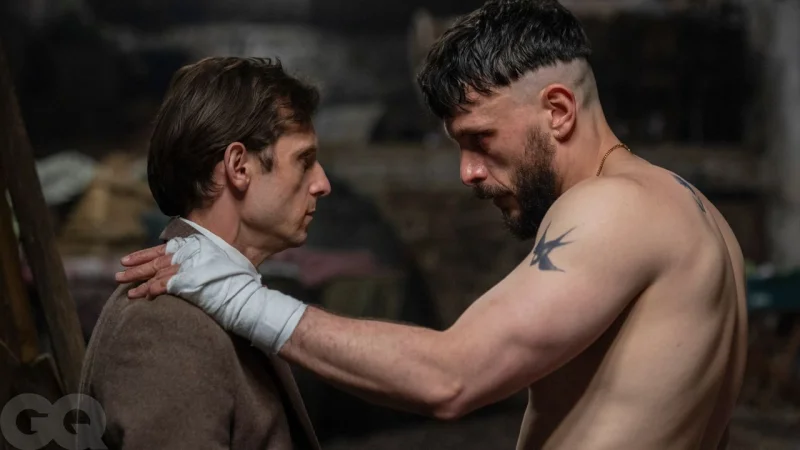
Richard Gadd’s Half Man ends in a prison scene that strips the series to its rawest confession: Ruben tells Niall that his father sexually abused him. It is the finale’s penultimate blow, and it changes the whole shape of what the show has been building toward.
That ending is drawing attention now because the series has been selling something sharper than a standard drama. Gadd, whose Baby Reindeer was his first series, opens each episode with wedding reception scenes whose timeline never quite settles into a logical order. The result is a story that looks grounded at first glance, then starts to drift into something stranger. By episode four, it has moved into a slow-motion world washed in ethereal music, while three men storm a barn door and wedding guests watch from a distance with an eerie calm before police cars and officers arrive with battering rams.
The prison scene makes the emotional logic explicit. Ruben does not just confess abuse; he explains the damage in words that are brutal in their simplicity. “It fucks you up man,” he says. “It makes you a fucking half-man.” Then he adds, “in a lot of ways it’s [also] the closest I’ve ever been with someone. Is this too much?” The line lands because it folds pain, shame and intimacy into the same breath, and because the relationship between Ruben and Niall has already been framed as something deeper than a normal confrontation.

That framing matters. The article on the finale reads Ruben and Niall as two unbalanced aspects of a single self, “two sides of the same face of a mythic anti-hero.” In that sense, the prison exchange is not just a plot reveal but the series’ emotional center of gravity. Half Man also appears to be doing something Gadd could not do as freely in Baby Reindeer: using fiction to move between personal trauma and a wider crisis of masculinity without having to keep its timeline neatly pinned down.
That freedom is also what makes the finale slippery. The show presents itself at first as uncompromising realism, then keeps breaking that promise with scenes that feel dreamlike, unmoored and almost ceremonial. The wedding reception framing, the slow-motion sequence, the surreal calm around the barn attack: each one pushes the viewer away from straight chronology and toward something more symbolic. By the time Ruben speaks in the prison scene, the series has already trained the audience to accept that reality here is being filtered through memory, damage and myth.
What remains unanswered is not whether Ruben was abused; the finale makes that plain. It is what the confession means for Niall, and whether the series sees that moment as reconciliation, recognition or another fracture between two men who seem to be carrying the same wound from opposite sides. Gadd leaves that hanging, and the silence after the confession is the part that stays with you.