


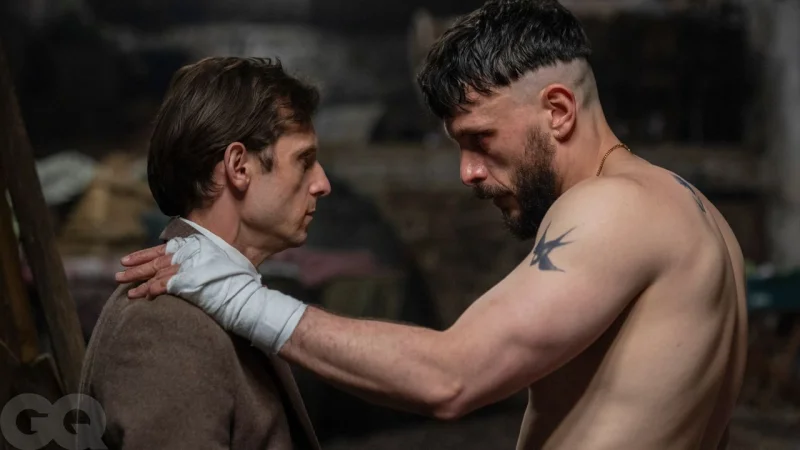
Half Man ends by putting its ugliest truth in the open. In the finale’s penultimate prison scene, Ruben tells Niall that his father sexually abused him, and the confession lands as the moment the story stops circling the wound and names it.
That is why Half Man Ending Explained is being searched now: the finale does not close with neat answers, but with a revelation that recasts everything before it. Ruben says, “It fucks you up man,” then adds that it “makes you a fucking half-man,” before asking, “in a lot of ways it’s [also] the closest I’ve ever been with someone. Is this too much?” The line is brutal, but it also exposes the strange intimacy at the center of the series. Ruben is not talking only about damage. He is talking about the way damage shapes identity, attachment and shame all at once.

For much of its run, Half Man looks like uncompromising realism. The wedding reception scenes that open each episode seem anchored in ordinary life, yet their timeline cannot be pieced together logically. The hospital scene is even more unsettling: an NHS ward sits empty and dimly lit, with no patients, no staff and not even a beeping monitor. Then episode four pushes the story into a slow-motion world washed in ethereal music, while three men storm a barn door and wedding guests watch calmly from a distance before police cars and officers arrive with battering rams. The return to normal time is abrupt. The effect is not decorative. It is the point.
That visual logic is what makes the finale’s prison confession feel both specific and larger than itself. Dreams do not obey time, and the series behaves like one. The story’s mythic frame is close to the thinking of Freud, Jung and Joseph Campbell: dreams are generated from the unconscious, Jung linked them to a collective unconscious, and Campbell argued that books, film and television can work as public dreams. On that reading, Ruben and Niall are not simply two characters in conflict. They are two unbalanced aspects of a single self, two sides of the same face of a mythic anti-hero.
The series keeps that idea alive right up to the end by refusing to settle into plain chronology or plain explanation. That is also why the finale feels unresolved even after the confession: the story gives the emotional truth, but not the comfort of a clean aftermath. What matters next is not a tidy wrap-up. It is the fact that Ruben has finally said what was done to him, and the series leaves that admission hanging in the air like the last image after a dream you are still trying to understand.
