


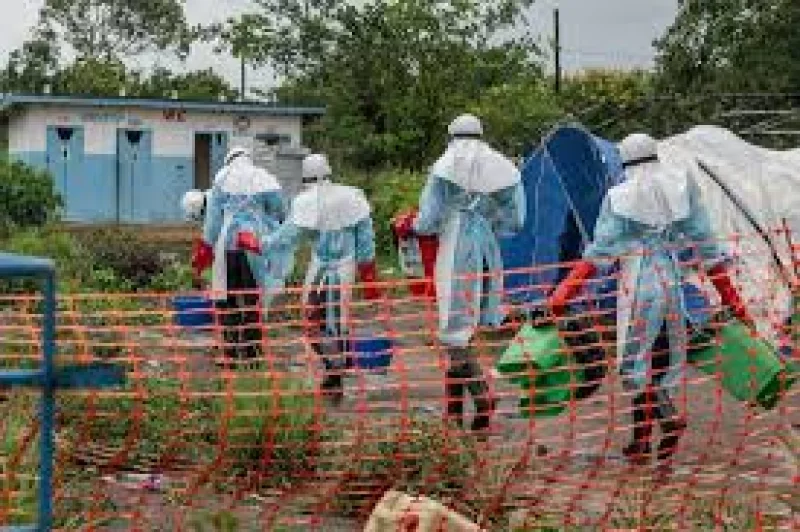
Northeastern University researchers are helping public health teams respond to the Ebola outbreak in Central Africa, using intelligence, AI analysis and risk models to guide decisions as the count of suspected cases and deaths keeps changing. The work is aimed at a moving target: 906 suspected cases and 223 suspected deaths were being tracked as of Wednesday, May 27.
Jessica Davis, a research assistant professor in the department of public health and health sciences and a core faculty member at the Network Science Institute, said the outbreak remains hard to measure because the numbers are still suspected. “Everything is still suspected, so it’s hard to even know the reach of the outbreak,” she said. That uncertainty is exactly why the keyword is drawing attention now: the outbreak is active, the numbers are rising, and health officials need help figuring out where the disease may spread next.
Alessandro Vespignani, director of the Network Science Institute and the Sternberg family distinguished professor in physics at Northeastern University, said the team is not working on the ground but is supplying the intelligence that responders need. “One of the first lines of defence is intelligence,” he said. Researchers are trying to determine which countries are at risk of expansion, how best to direct border screening and travel limitations, and whether mitigation efforts are having any effect. They are also trying to pin down the number and location of cases, information that can shape surveillance and forecasting.
The problem is that the data itself can blur the picture. Vespignani said daily increases do not automatically show how fast the epidemic is growing, because they can also reflect a surveillance system that is only now catching up. On May 15, lab tests confirmed deaths from the Bundibugyo strain of Ebola in Ituri Province in the Democratic Republic of the Congo and in Kampala, Uganda, and two days later the World Health Organization declared the outbreak a public health emergency of international concern. Since then, Northeastern researchers have been feeding models and analysis into the response, even as the extent of the outbreak remains difficult to map with confidence.
The center behind much of that work, the Center for Advanced Epidemic Analytics and Predictive Modeling Technology, or EPISTORM, is designed to improve modeling, forecasting tools and the use of data during health emergencies. It is funded by Insight Net, a CDC network focused on infectious disease threats. Northeastern researchers also worked on previous major Ebola outbreaks on the continent, but this outbreak still has a basic question hanging over it: whether the response can get ahead of the spread before the suspected counts turn into something far larger.
