
People marked Eid al-Adha at mosques and train stations, in the middle of roads and along the edge of the sea, in a display of faith that turned ordinary public places into prayer spaces across parts of Southeast Asia.
The scenes came as Muslims observed Eid al-Adha, the Festival of Sacrifice and the second major holiday in Islam. During the holiday, approximately 2 billion pilgrims worldwide offered prayers as a sign of devotion, adherence and unity, underscoring the scale and shared rhythm of the observance even in places far from the annual gathering itself.
The photo-focused coverage from Indonesia, the Philippines and Malaysia captured worshippers wherever they could gather. Some stood shoulder to shoulder at mosques. Others prayed at train stations, while still others took to open ground in the middle of roads or faced the water at the sea’s edge. The settings were different, but the purpose was the same: to mark a day that binds millions of believers through ritual and remembrance.
Eid al-Adha, also known as the Festival of Sacrifice, sits at the center of the Islamic calendar as a moment of devotion and collective worship. The holiday’s reach is measured not just by the number of people who observe it, but by the way its rites are carried into daily life, from packed city spaces to coastal edges where the crowd is small but the act is no less formal.
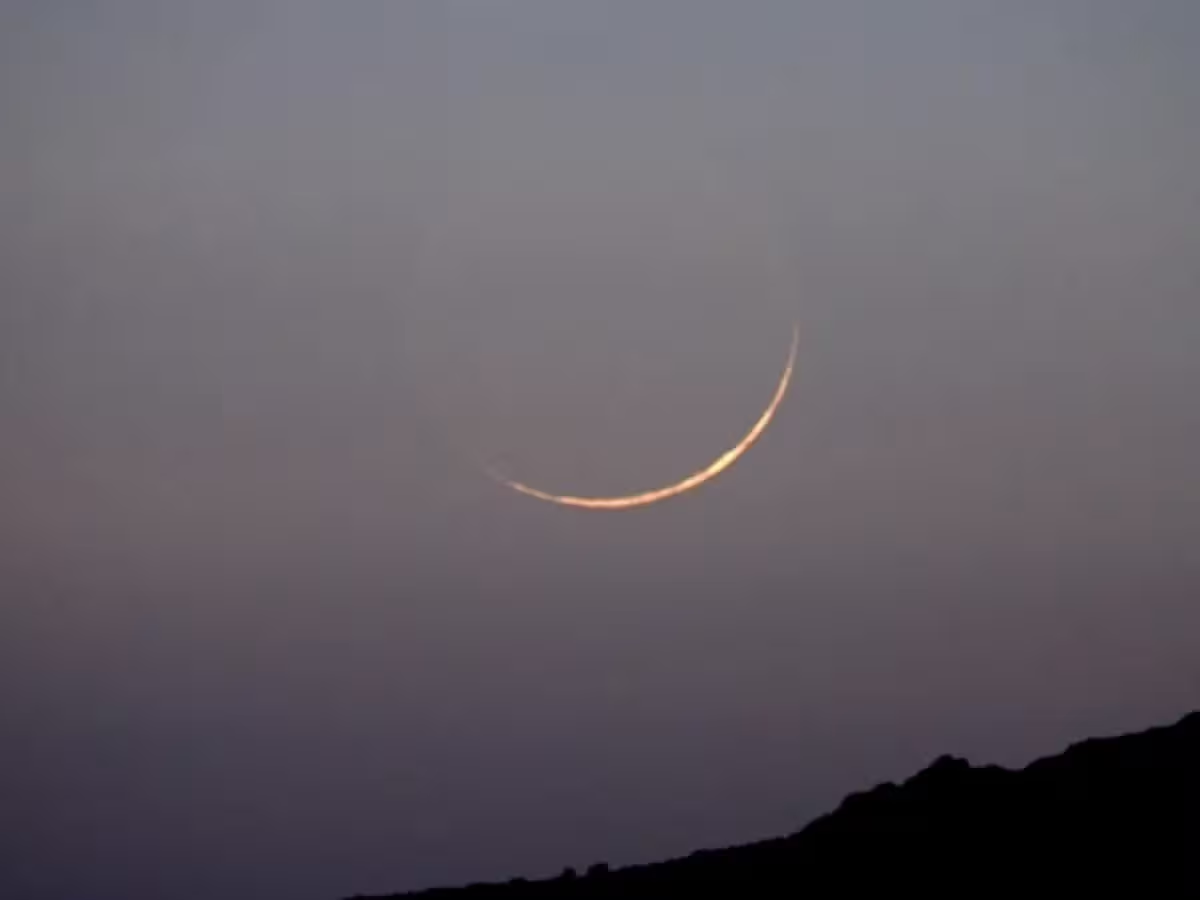
The variety of locations also shows how public life adapts around major religious observances in the region. Train stations become gathering points. Roads are briefly transformed. Mosques overflow. By using the spaces available, worshippers make the holiday visible to everyone around them, turning an ordinary commute or waterfront into part of the observance.
That contrast between the sacred and the everyday is what gives the images their force. Eid May, as the holiday is being framed in this coverage, is not only a date on the calendar. It is a shared act that can appear in a station platform, on a roadway or beside the sea, and still carry the same meaning wherever it is held.
For readers following the holiday beyond these images, the scale of the observance remains the central fact. Roughly 2 billion pilgrims worldwide took part in prayers during Eid al-Adha, a reminder that the holiday’s reach stretches across countries, climates and public spaces. A separate piece on a moon study suggests Neptune’s Nereid may be a lone survivor, but the day’s dominant story here is the gathering of worshippers and the places they chose to meet it.
As the celebrations continue in communities across Indonesia, the Philippines and Malaysia, the pictures leave little doubt about what Eid al-Adha looks like on the ground: crowded, improvised and deeply communal, with faith spilling beyond mosque walls into the spaces people use every day.